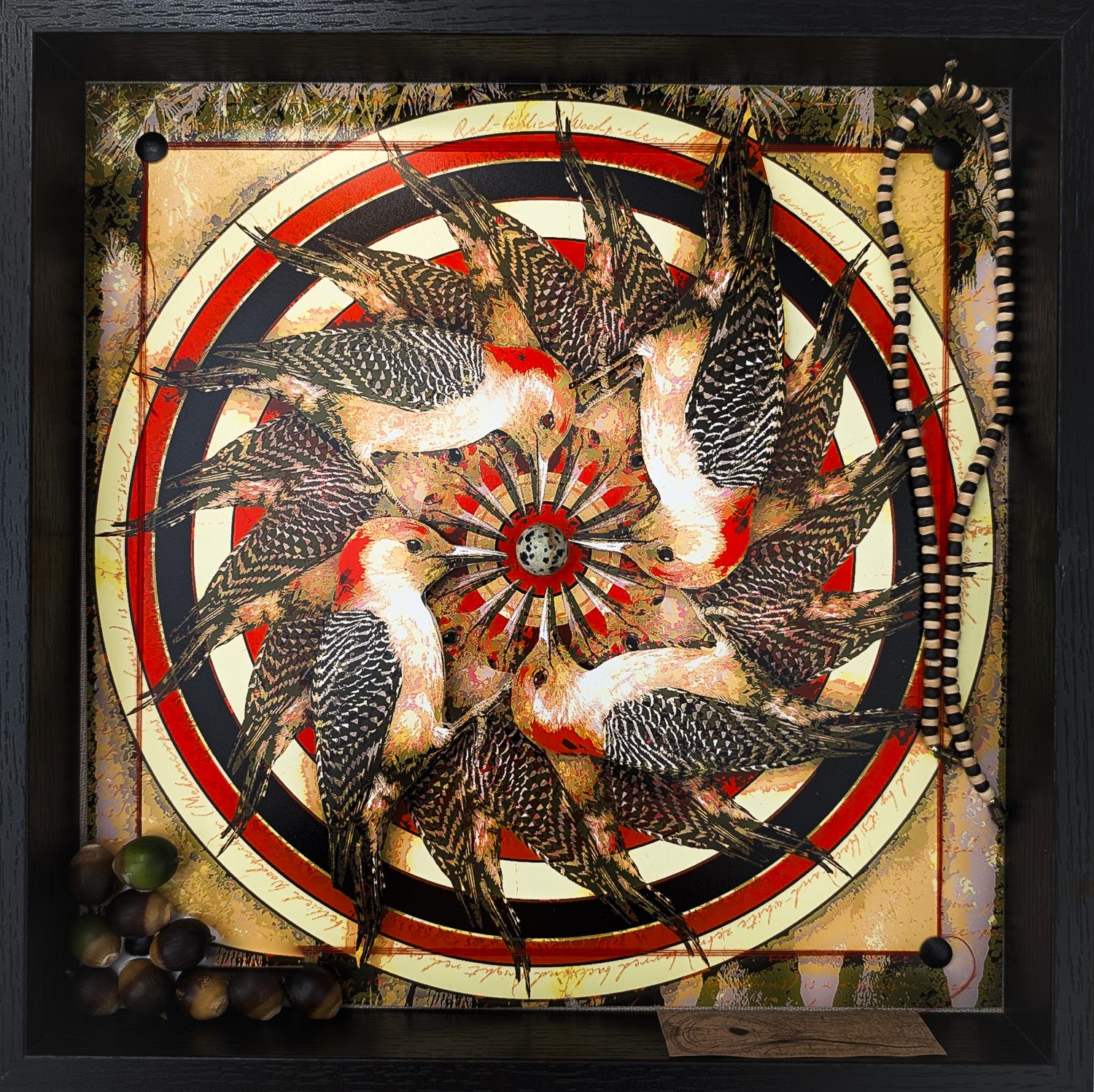
The red-bellied woodpecker (Melanerpes carolinus) is often a bird of deceptive names and vibrant habits. While casual observers look in vain for a bright crimson belly—discovering instead just a soft, blush-pink wash on its lower abdomen—the bird’s real hallmarks are its fiery scarlet nape and the crisp, zebra-like barred plumage of its mantle. In this assemblage, that kinetic forest energy is distilled into a striking, meditative pinwheel.
Arranged in concentric cycles of rust-red, ivory, and soot-black, the birds spiral inward like spokes on an ecological compass. Four dimensional figures converge at the center, their tapered bills aimed directly toward a small, speckled sphere that evokes both a fragile egg and an earthly core. The script flowing around the target rings echoes the classic cadence of Victorian field journals, lending an air of archival obsession to a bird most often seen hammering enthusiastically at pine snags and backyard suet blocks.
In the bottom corner rests an intentional cache of fresh and cured acorns—a direct homage to the species’ role as an industrious mast harvester and seed horder. Coupled with the carved bead strand draping down the inner wall, the shadow box transcends straightforward taxidermy or illustration. It functions as a naturalist’s reliquary, balancing the wild, chaotic rhythm of southeastern pine flatwoods and live oak canopies with the quiet symmetry of sacred geometry. It captures not just the bird’s anatomy, but its enduring instinct: circling, storing, and centering life within the ancient timber.