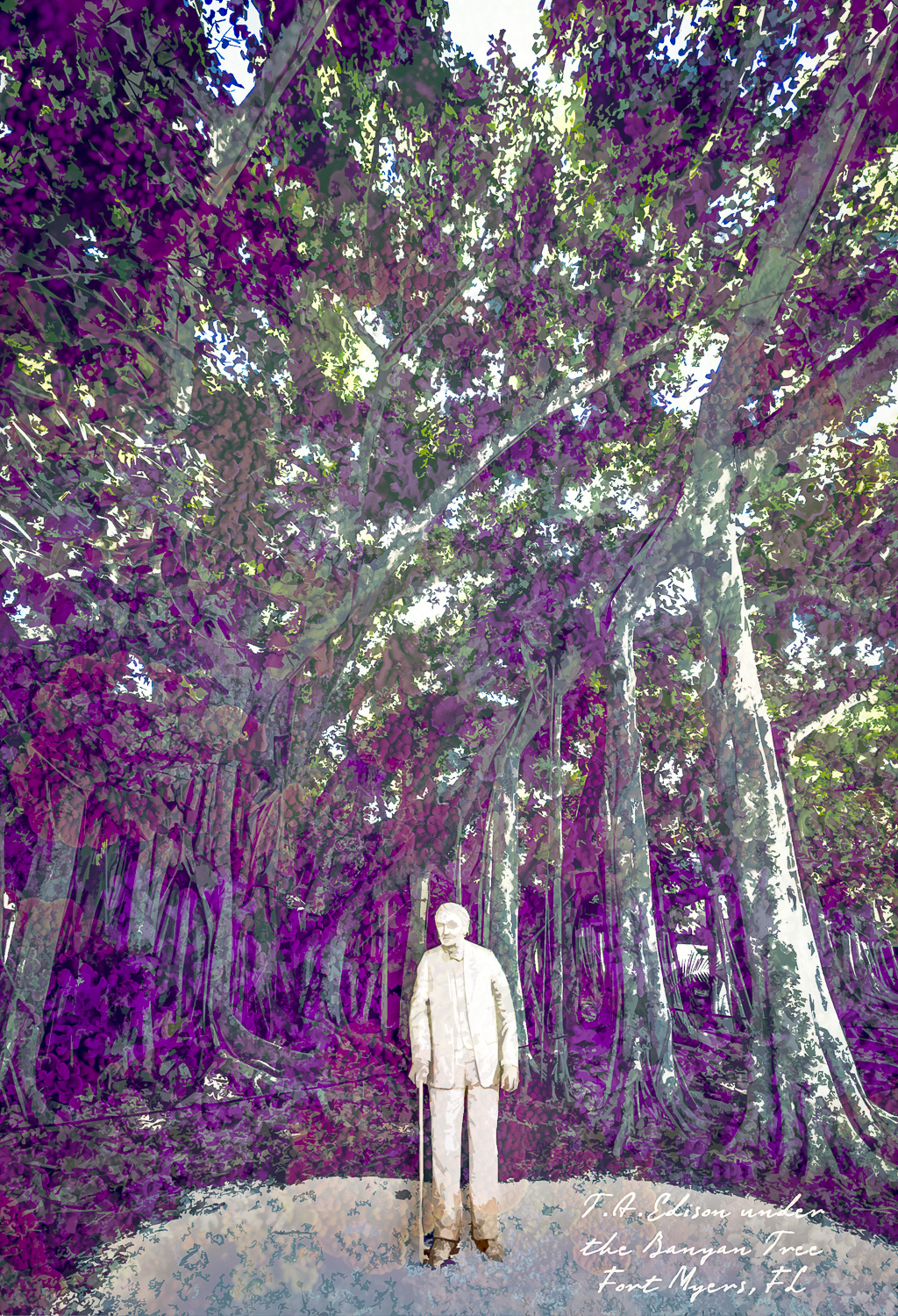
In 1925, tire magnate Harvey Firestone gifted his close friend Thomas Edison a small, four-foot sapling of Ficus benghalensis—a sacred banyan native to India. Planted at Edison’s winter retreat, Seminole Lodge in Fort Myers, Florida, the tree was not merely ornamental; it was part of a critical industrial quest.
During the 1920s, global rubber supplies were largely controlled by British and Dutch monopolies. Concerned that a foreign embargo or wartime blockade could cripple American industry, Edison joined forces with Firestone and Henry Ford to establish the Edison Botanic Research Corporation in 1927. Their goal was to identify an indigenous, fast-growing domestic source of natural latex. Edison tested over 17,000 plant species in his Fort Myers laboratory, including the banyan.
While the banyan’s milky white sap did contain latex, Edison discovered its extraction was labor-intensive and its yield too low for commercial vulcanization. He ultimately abandoned the ficus in favor of Solidago leavenworthii (goldenrod), which he crossbred into 12-foot stalks capable of yielding over 12% rubber.
Though it failed as an industrial solution, Firestone’s modest sapling flourished into an ecological titan. Today, it stands as one of the largest banyan specimens in the continental United States. Spanning roughly an acre, the tree features an immense canopy supported by hundreds of aerial roots that drop from high branches to form pillar-like secondary trunks, serving as a living monument to Edison’s relentless experimental drive.