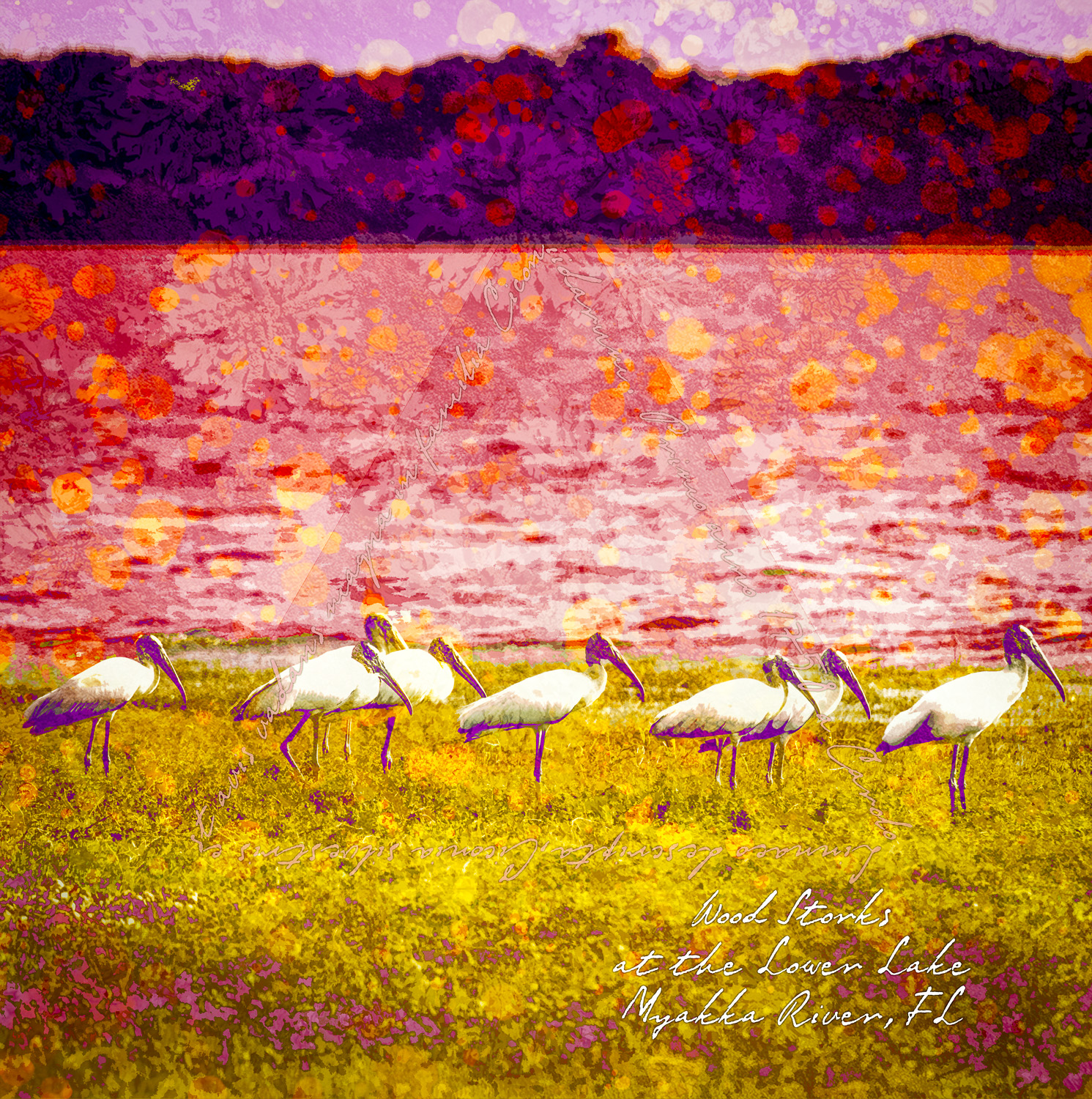
The Wood Stork (Mycteria americana) is a striking, prehistoric-looking wading bird that serves as a vital indicator species for the health of Florida’s wetlands. Standing over three feet tall with a wingspan stretching more than five feet, it is the only species of stork that breeds natively in North America.
Appearance and Unique Feeding Strategy
At a glance, the Wood Stork is defined by its stark contrasts. Its body is covered in brilliant white plumage, offset by jet-black flight feathers along the edges of its wings, which are most visible when the bird is soaring on thermal updrafts. Its most distinctive features, however, are its featherless, scaly gray head and neck, paired with a long, thick, down-curved bill. This unique, rugged head structure has earned it regional nicknames like “flinthead” or “ironhead.”
Wood Storks do not hunt by sight. Instead, they rely on a highly specialized technique called tactolocation (tactile feeding) to catch food in murky water. A stork wades through shallow ponds, cypress strands, or marshes, keeping its bill submerged and partially open. It uses its feet to stir up the bottom sediment, startling prey. The moment a fish, frog, or crayfish touches the inside of the bill, the jaws snap shut with a reflex speed of roughly 25 milliseconds—one of the fastest recorded stimulus-response times among vertebrates.
The Dynamics of Breeding and Hydrology
The nesting cycle of Florida’s Wood Storks is intimately tied to the state’s seasonal water cycles. They nest colonially in the upper canopies of cypress swamps, mangroves, or flooded trees, often building large stick nests directly over open water to keep raccoons and other climbing predators at bay.
Successful breeding depends entirely on a predictable transition from the wet summer season to the dry winter season.
Because a nesting pair requires an immense amount of food to raise a clutch of two to three chicks—frequently exceeding 400 pounds of fish over a single breeding season—they can only successfully rear young when falling water levels trap and concentrate prey into dense, shallow pools. If unseasonal winter rains flood the landscape and disperse the fish, adult storks will completely abandon their nests.
Conservation Status and Outlook
Historically concentrated heavily in the Everglades, Wood Storks suffered massive population declines in the mid-to-late 20th century due to human disruption of South Florida’s natural water flow. This led to their listing as an endangered species in 1984.
In response to habitat loss, the storks shifted their breeding ranges northward, establishing new colonies across central and northern Florida, as well as parts of Georgia and South Carolina. Due to this geographic adaptation and intensive wetland restoration efforts, the U.S. Fish and Wildlife Service reclassified the Wood Stork from endangered to threatened. Today, protecting their remaining foraging wetlands remains essential to ensuring the long-term survival of this ancient Florida resident.