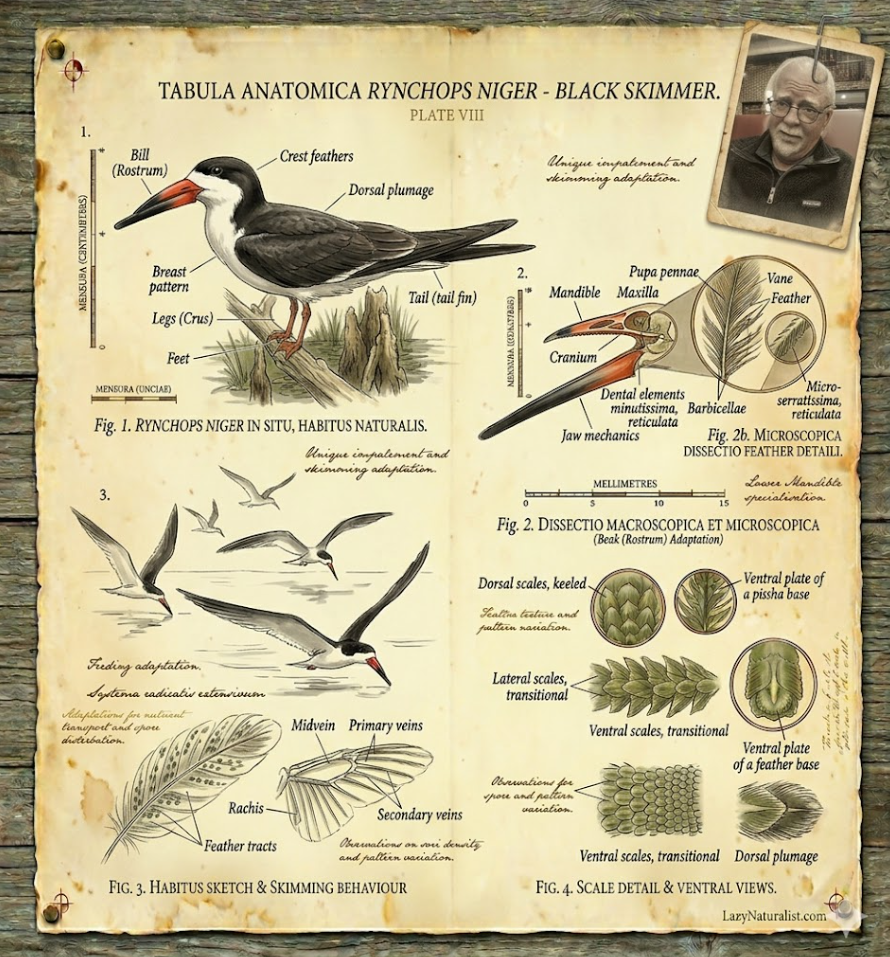
If you find yourself strolling along the quartz-white sands of Lido Key or Siesta Key at dusk, you might witness a silhouette that feels more like a phantom than a bird. Gliding mere inches above the Gulf’s glassy surface, a creature with a massive wingspan and a strangely weighted head cuts a silent line through the water. This is the Black Skimmer (Rynchops niger), one of Florida’s most charismatic—and threatened—coastal residents.
In Sarasota, the Black Skimmer is more than just a local bird; it is a symbol of the delicate balance between thriving tourism and wildlife conservation. With their tuxedo-like plumage and “underbite” beak, these birds are an essential, if fragile, part of the Suncoast’s ecological identity.
An Anatomical Marvel: The “Scissors” of the Sea
The Black Skimmer is a masterclass in specialized evolution. At first glance, their proportions seem almost comical. They possess long, pointed wings and a bright orange-and-black beak where the lower mandible is significantly longer than the upper.
This isn’t a genetic fluke; it is a highly evolved tool for a unique hunting method called “skimming.”
Tactile Hunting: Unlike gulls that scavenge or terns that plunge-dive, the Skimmer flies low with its lower beak submerged. When it strikes a fish, the upper beak snaps shut like a spring-loaded trap.
Night Vision: Because they often hunt at night or during twilight (crepuscular activity) to avoid competition and find calmer waters, they are the only bird species known to have vertical slit pupils, similar to a cat’s. This allows them to cut out the harsh glare of the Florida sun by day while maximizing light intake by night.
Sarasota: A Critical Stronghold
Sarasota County, particularly Lido Key, serves as one of the most significant nesting sites for Black Skimmers in the state of Florida. While these birds can be found along the Atlantic and Gulf coasts, the expansive, stable beaches of Sarasota provide the specific conditions they require for “beach-nesting.”
Why Sarasota?
The region offers a “perfect storm” of biological necessities:
Proximity to Foraging: The nutrient-rich passes (like Big Sarasota Pass and New Pass) provide a steady supply of small fish like silversides and mullet.
Social Structure: Skimmers are colonial nesters. They thrive in large groups, often nesting alongside Least Terns. Sarasota’s wide beaches allow hundreds of pairs to congregate, providing “strength in numbers” against predators.
The Drama of the Colony: Life on the Sand
Nesting season in Sarasota typically runs from May through August. Unlike most birds that build intricate nests in trees, Skimmers are minimalist. They create “scrapes”—simple depressions in the sand where the female lays three to five speckled eggs.
The Heat Challenge
On a July afternoon in Sarasota, sand temperatures can soar. To keep the embryos from literally cooking, parent Skimmers perform a “belly soak.” They fly to the water, drench their breast feathers, and return to the nest to cool the eggs via evaporation.
Survival of the Fittest
Once the chicks hatch, they are the color of salt and pepper, blending perfectly with the shell hash of the beach. While the parents are out fishing, the chicks rely on camouflage to stay invisible. However, as they grow, they become more mobile, often huddling in “crèches” (nurseries) at the water’s edge, guarded by a few sentinel adults.
The Conflict: Birds vs. Blankets
The primary challenge for Sarasota’s Skimmers is that they love the same thing we do: the beach. Because they nest directly on the sand, they are incredibly vulnerable to human disturbance. A single dog running off-leash or a kite flying too low can cause an entire colony to “flush” (take flight in panic). When parents leave the nest:
Predation: Crows and gulls can swoop in and snatch eggs or chicks in seconds.
Thermal Stress: Without the shade of a parent’s body, a chick can die from heatstroke in less than fifteen minutes.
The “Stewardship” Movement
Sarasota has become a leader in coastal bird protection through organizations like Audubon Florida and the Sarasota Audubon Society. During nesting season, “bird stewards” wrap large sections of the beach in symbolic fencing (twine and signs). These volunteers spend their weekends educating tourists, reminding beachgoers that “sharing the shore” is the only way these birds survive.
Threats Beyond the Beach
While local disturbance is the immediate threat, the Black Skimmer faces broader environmental hurdles in Southwest Florida:
Red Tide
Blooms of Karenia brevis kill the small fish Skimmers rely on and can lead to brevetoxin poisoning in the birds.
Sea Level Rise
Increasing “king tides” and storm surges can wash away entire colonies in a single afternoon.
Plastic Pollution
Skimmers often mistake floating plastic debris for prey, leading to ingestion or entanglement.
How to Help: A Guide for Locals and Visitors
If you are visiting Siesta, Lido, or Longboat Key, you can play a direct role in the survival of the Black Skimmer.
Respect the Rope: Never enter the posted nesting areas. Even if you don’t see a bird, an egg could be right under your feet.
Leash Your Pets: Dogs are perceived as apex predators by Skimmers. Even a “friendly” dog can cause a colony to abandon their nests permanently.
Trash In, Trash Out: Ensure no fishing line or food scraps are left behind. Food scraps attract crows and raccoons, which then stay to eat the Skimmer chicks.
Give Them Space: If the birds start diving at you or “barking” (they sound remarkably like small dogs), you are too close. Back away slowly.
The Future of the Skimmer in Sarasota
The Black Skimmer is currently listed as a State-Threatened Species in Florida. However, there is hope. In recent years, the Lido Key colony has seen successful fledging cycles, thanks largely to the intensive efforts of local volunteers and the Florida Fish and Wildlife Conservation Commission (FWC).
Watching a Skimmer “bark” at a sunset or seeing a fledgling take its first clumsy flight over the Gulf is a reminder of why Sarasota’s natural beauty is worth protecting. These birds are the true “locals”—ancestral residents of the shoreline who remind us that the beach is not just a playground, but a nursery for the wild.
The next time you see that strange, orange-beaked bird slicing the water at twilight, take a moment to appreciate the miracle. In a world of concrete and high-rises, the Black Skimmer remains a stubborn, beautiful reminder of Florida’s wild heart.
| Black skimmer | |
|---|---|
 | |
| Black skimmer in breeding plumage. | |
Scientific classification  | |
| Kingdom: | Animalia |
| Phylum: | Chordata |
| Class: | Aves |
| Order: | Charadriiformes |
| Family: | Laridae |
| Genus: | Rynchops |
| Species: | R. niger |
| Binomial name | |
| Rynchops niger | |
 | |
| Synonyms | |
|
Rynchops fulva Linnaeus, 1758 | |

The black skimmer (Rynchops niger) is a tern-like seabird, one of three similar bird species in the skimmer genus Rynchops in the gull family Laridae. It breeds in North and South America. Northern populations winter in the warmer waters of the Caribbean and the tropical and subtropical Pacific and Atlantic coasts, but South American populations make only shorter movements in response to annual floods which extend their feeding areas in the river shallows.
Taxonomy
The black skimmer was described by the Swedish naturalist Carl Linnaeus in 1755 in the tenth edition of his Systema Naturae and given the binomial name Rynchops niger.[2] The genus name Rynchops is from the Ancient Greek ῥυvχος/rhunkhos meaning "bill" and κοπτω/koptō meaning "to cut off". The specific niger is the Latin word for "black".[3] The black skimmer is one of three species in the genus Rynchops.[4]
There are three subspecies:[4]
| Image | Subspecies | Description | Distribution |
|---|---|---|---|
 | R. n. niger (Linnaeus, 1758) | migratory, breeds on the Atlantic coast of North America, and from southern California to Ecuador in the Pacific | |
.jpg) | R. n. cinerascens (von Spix, 1825) | is larger, has dusky underwings, only narrow white fringe to its black tail | breeds in northern and northeastern South America and the Amazon basin |
_(30997653194).jpg) | R. n. intercedens (Saunders, 1895) | occurs on the rest of the Atlantic coast of South America south to central Argentina | |
Description
The black skimmer is the largest of the three skimmer species. It measures 40–50 cm (16–20 in) long with a 107–127 cm (42–50 in) wingspan.[5] This species ranges from 212 to 447 g (7.5 to 15.8 oz), with males averaging about 349 g (12.3 oz), as compared to the smaller females 254 g (9.0 oz).[6] The basal half of the bill is red, the rest mainly black, and the lower mandible is much-elongated. The eye has a dark brown iris and catlike vertical pupil, unique for a bird. The legs are red. The call is a barking kak-kak-kak.[7]
Adults in breeding plumage have a black crown, nape and upper body. The forehead and underparts are white. The upper wings are black with white on the rear edge, and the tail and rump are dark grey with white edges. The underwing colour varies from white to dusky grey depending on region.[7]
Non-breeding adults have paler and browner upperparts, and a white nape collar. Immature birds have brown upperparts with white feather tips and fringes. The underparts and forehead are white, and the underwings as the adult.[7]
Behaviour and ecology


.jpg)
_in_flight.jpg)
They spend much time loafing gregariously on sandbars in the rivers, coasts and lagoons they frequent.
Breeding
The black skimmer breeds in loose groups on sandbanks and sandy beaches in the Americas, the three to seven heavily dark-blotched buff or bluish eggs being incubated by both the male and female. The chicks leave the nest as soon as they hatch and lie inconspicuously in the nest depression or "scrape" where they are shaded from high temperatures by the parents. They may dig their own depressions in the sand at times. Parents feed the young almost exclusively during the day with almost no feeding occurring at night, due to the entire population of adults sometimes departing the colony to forage. Although the mandibles are of equal length at hatching, they rapidly become unequal during fledging.[8]
Feeding
Skimmers have a light graceful flight, with steady beats of their long wings. They usually feed in large flocks, flying low over the water surface with the lower mandible skimming the water for (in order of importance) small fish, insects, crustaceans and molluscs[9] caught by touch by day or especially at night.[8] Fish prey species include Odontesthes argentinenesis, Brevoortia aurea, Anchoa marinii, Lycengraulis grossidens, Engraulis anchoita, Pomatomus saltatrix, Mugil cephalus, Fundulus heteroclitus, Anchoa mitchilli[10] and Odontesthes incisa.[9]
.jpeg)
Female skimmers are more likely to be involved in caring for and feeding their chicks, though male skimmers have been observed feeding larger prey to their older chicks. The survival of black skimmer chicks is highly dependent on the availability and quality of adequately sized prey closely located to the nest site. The youngest chicks (under six days old) are fed as often as twelve times per day, with the oldest chicks (over twelve days old) being fed at least once per day. They primarily feed during low light levels at night, but have been observed to forage in the daytime in preparation for nighttime feeding.[11]
Development
 Chick and egg
 Chick
Chick Adult feeding a chick
 Juveniles at four weeks. They are distinguished from adults by the white speckled pattern on their wings and body.
 Adult winter plumage


Notes
- ↑ BirdLife International (2025). "Rynchops niger". IUCN Red List of Threatened Species. 2025 e.T22694256A281864060. doi:10.2305/IUCN.UK.2025-2.RLTS.T22694256A281864060.en.
- ↑ Linnaeus, Carl (1758). Systema Naturae per regna tria naturae, secundum classes, ordines, genera, species, cum characteribus, differentiis, synonymis, locis (in Latin). Vol. 1 (10th ed.). Holmiae:Laurentii Salvii. p. 138. Archived from the original on 2017-12-01. Retrieved 2017-11-21.
{{cite book}}: CS1 maint: publisher location (link) - ↑ Jobling, James A. (2010). The Helm Dictionary of Scientific Bird Names. London: Christopher Helm. pp. 270, 344. ISBN 978-1-4081-2501-4.
- 1 2 Gill, Frank; Donsker, David, eds. (2019). "Noddies, gulls, terns, auks". World Bird List Version 9.2. International Ornithologists' Union. Archived from the original on 8 August 2019. Retrieved 24 June 2019.
- ↑ "Black Skimmer Life History, All About Birds, Cornell Lab Of Ornithology". 2011. Archived from the original on 2018-09-24. Retrieved 2011-10-20.
- ↑ CRC Handbook of Avian Body Masses by John B. Dunning Jr. (Editor). CRC Press (1992), ISBN 978-0-8493-4258-5.
- 1 2 3 Gochfeld, M.; Burger, J.; Lefevre, K. L. (4 March 2020). Billerman, Shawn M (ed.). "Black Skimmer (Rynchops niger)". Birds of the World. Cornell Lab of Ornithology, Ithaca, NY. doi:10.2173/bow.blkski.01. S2CID 216218414. Archived from the original on 17 August 2023. Retrieved 23 September 2021.
{{cite journal}}: CS1 maint: multiple names: authors list (link) - 1 2 Kaufman, Kenn (13 November 2014). "Black skimmer (Rynchops niger)". Guide to North American Birds. Audubon. Archived from the original on 2 November 2023. Retrieved 23 September 2021.
- 1 2 Mariano-Jelicich, R; Favero, M.; Silva, M.P. (February 2003). "Fish Prey of the Black Skimmer Rynchops Niger at Mar Chiquita, Buenos Aires Province, Argentina" (PDF). Marine Ornithology. 31: 199–202. Archived (PDF) from the original on 2018-04-26. Retrieved 2009-06-29.
- ↑ Pandhi, Mithil (2007). Dewey, Tanya; Fraser, Ann (eds.). "Rynchops niger (Black skimmer)". Animal Diversity Web. Archived from the original on 12 August 2023. Retrieved 30 May 2023.
- ↑ Forys, Elizabeth A. (2017-01-01). "Investigating Black Skimmer Chick Diets Using Citizen Science and Digital Photography". Southeastern Naturalist. 16 (3): 317. doi:10.1656/058.016.0301. ISSN 1528-7092.
References
- ffrench, Richard (1991). A Guide to the Birds of Trinidad and Tobago (2nd ed.). Comstock Publishing. ISBN 0-8014-9792-2.
- Hilty, Steven L (2003). Birds of Venezuela. London: Christopher Helm. ISBN 0-7136-6418-5.
- A guide to the birds of Costa Rica by Stiles and Skutch ISBN 0-8014-9600-4
- Seabirds by Harrison, ISBN 978-0-7136-3510-2
External links
- "Black skimmer media". Internet Bird Collection.
- Field Guide on Flickr
- Stamps (for Antigua, Mexico, Nevis, Nicaragua, Uruguay) with Range Map at bird-stamps.org
- Black skimmer photo gallery at VIREO (Drexel University)
- Interactive range map of Rynchops niger at IUCN Red List
| National | |
|---|---|
| Other | |
