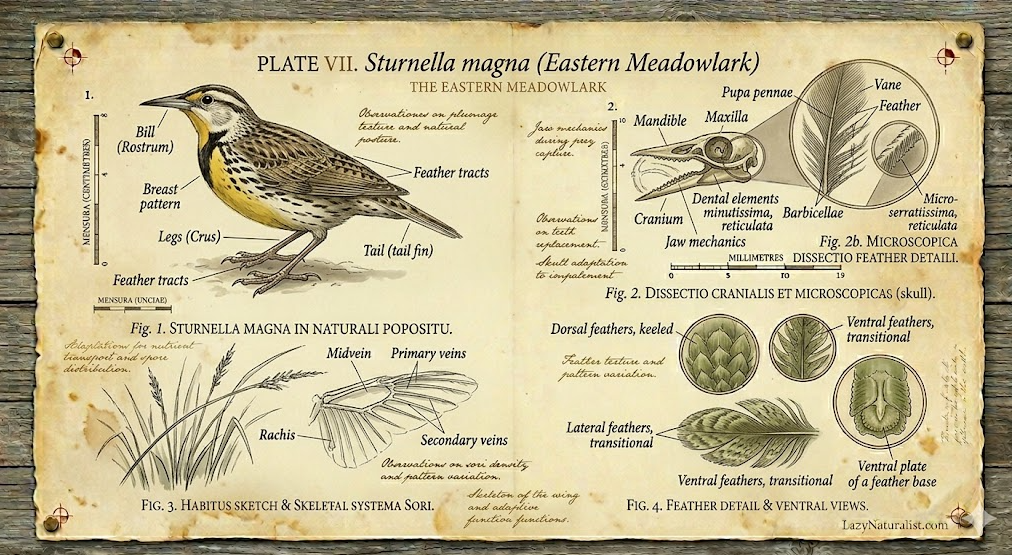
While the “Sunshine State” is often associated with coastal herons and swamp-dwelling egrets, the Eastern Meadowlark represents a different side of Florida: the vast, open interior. From the historical “Florida Dry Prairie” to modern-day sod farms, this striking icterid—a member of the blackbird family—has carved out a niche in a state rapidly losing its open spaces.
Appearance: A Masterclass in Contrast
At first glance, an Eastern Meadowlark on the ground is nearly invisible. Evolution has gifted the species with a “cryptic” dorsal pattern—a complex tapestry of streaked browns, blacks, and buffs that mimics the dried thatch and shadows of a grassy field. This camouflage is essential for a bird that spends the majority of its life walking on the ground rather than hopping through the canopy.
However, once the bird takes to a fence post or a cabbage palm to sing, it reveals one of the most stunning color palettes in the avian world.
The Breast: A brilliant, saturated lemon-yellow that glows against the green of a summer pasture.
The “V”: A bold, jet-black chevron or “V” shape draped across the chest, acting as a high-contrast visual signal during territorial displays.
The Profile: Chunky and short-tailed, roughly the size of an American Robin, but with a longer, spear-like bill designed for “gaping”—inserting the bill into the soil and prying it open to reveal hidden insects.
The Florida Range and Habitat
In Florida, the Eastern Meadowlark is a year-round resident. While northern populations may migrate south during harsh winters, Florida’s birds are largely sedentary, staying within their established territories throughout the seasons.
The Dry Prairie
The Eastern Meadowlark’s ancestral home in Florida is the Florida Dry Prairie, a unique ecosystem found primarily north and west of Lake Okeechobee. This landscape is characterized by low-growing saw palmetto, wiregrass, and a lack of canopy trees. For the meadowlark, this provides the perfect balance: enough cover to hide a nest, but enough visibility to spot a prowling caracara or a coachwhip snake.
Pastures and Sod Farms
As Florida’s native prairies were converted for agriculture, the Eastern Meadowlark proved surprisingly resilient—at least initially. The bird adapted to the vast cattle ranches of the interior. Today, some of the highest concentrations of meadowlarks in Florida are found on active ranches where “low-intensity” grazing keeps the grass at an ideal height. They have also moved into sod farms and airports, where the lack of trees mimics their natural habitat.
Behavior: Life on the Ground
Unlike many songbirds that hop, meadowlarks walk. They stroll through the grass with a rhythmic gait, probing the base of grass clumps for their primary prey: grasshoppers, crickets, beetles, and caterpillars.
The Ground Nest
Perhaps the most vulnerable aspect of the meadowlark’s life is its nesting habit. The female builds a remarkably sophisticated nest directly on the ground. She weaves dead grasses into a dome-shaped structure, often with a side entrance and a “runway” of flattened grass leading to it. This dome provides shade from the intense Florida sun and hides the eggs from aerial predators.
Polygyny: A Busy Social Life
In the world of Florida meadowlarks, the males are often “polygynous.” A single male, defending a high-quality territory with abundant food, may have two or even three females nesting within his boundaries. While the females do the heavy lifting of incubation, the male remains vigilant on a high perch, singing to warn off rivals and alert his mates to approaching danger.
The Meadowlark’s Song: A Florida Soundtrack
The song of the Eastern Meadowlark is a defining feature of the Florida countryside. It is often described as see-you-see-yeeer or spring-is-here. In Florida, where the seasons are subtle, the intensification of meadowlark singing in February and March is one of the truest indicators that the “breeding spring” has arrived.
The species is frequently confused with its look-alike cousin, the Western Meadowlark. While they look nearly identical, their songs are entirely different. Interestingly, where their ranges overlap in the central U.S., they rarely interbreed because they don’t “speak the same language.” In Florida, however, you only have to worry about the Eastern variety.
Conservation Challenges in the Sunshine State
Despite their adaptability, Eastern Meadowlark populations have plummeted by over 70% across North America since the 1960s. Florida reflects this trend as it faces unique pressures.
1. Habitat Loss and Fragmentation
The greatest threat to the meadowlark in Florida is the conversion of grasslands into residential developments. A meadowlark requires a relatively large, contiguous patch of grass—usually at least 5 to 10 acres—to establish a territory. When a ranch is subdivided into “quarter-acre lots” with houses and ornamental trees, the meadowlark disappears.
2. Mowing and Haying
Because they nest on the ground, meadowlarks are highly susceptible to agricultural machinery. In Florida, if a hay field is mowed in April or May, the nests—and the flightless chicks—are often destroyed. Conservationists urge Florida landowners to delay mowing until after the primary nesting season (late July) to allow the “second brood” of chicks to fledge.
3. Pesticide Use
As insectivores, meadowlarks are directly impacted by the heavy use of pesticides. A reduction in grasshoppers—the “bread and butter” of the meadowlark diet—means fewer chicks survive to adulthood. Furthermore, the birds can suffer from secondary poisoning by eating tainted insects.
Where to See Them in Florida
For birdwatchers and nature enthusiasts, Florida offers several premier locations to observe the Eastern Meadowlark in its natural element:
Kissimmee Prairie Preserve State Park
Central Florida
Year-round (Best in Spring)
Paynes Prairie Preserve State Park
Micanopy / Gainesville
Spring and Winter
Three Lakes Wildlife Management Area
Osceola County
Spring
Apalachicola National Forest
Panhandle
Spring
At Kissimmee Prairie Preserve, one can experience the meadowlark as it lived for thousands of years—among the wiregrass and palmetto, under one of the darkest skies in Florida.
Conclusion: A Heritage Worth Preserving
The Eastern Meadowlark is more than just a pretty bird on a fence post. It is an “indicator species.” When the meadowlark thrives, it means the grasslands are healthy, the insect populations are balanced, and the soil is vibrant. When the meadowlark’s song falls silent, it is a warning that an entire ecosystem—one that helps filter Florida’s groundwater and provides a home for the Florida Grasshopper Sparrow and the Burrowing Owl—is in trouble.
Protecting the Eastern Meadowlark in Florida requires a commitment to “working landscapes.” By supporting local cattle ranches that practice sustainable grazing and advocating for the preservation of native prairies, Floridians can ensure that the flutelike whistle of the meadowlark remains the enduring soundtrack of the Florida interior for generations to come.
| Eastern meadowlark | |
|---|---|
_Orange_Walk.jpg) | |
| Sturnella magna mexicana Belize | |
Scientific classification  | |
| Kingdom: | Animalia |
| Phylum: | Chordata |
| Class: | Aves |
| Order: | Passeriformes |
| Family: | Icteridae |
| Genus: | Sturnella |
| Species: | S. magna |
| Binomial name | |
| Sturnella magna | |
 | |
| S. magna range Breeding range Year-round range | |
| Synonyms | |
| Audio | |
| Song | |

The eastern meadowlark (Sturnella magna) is a medium-sized icterid bird, very similar in appearance to its sister species, the western meadowlark. It occurs from eastern North America to northern South America, where it is also most widespread in the east. The Chihuahuan meadowlark was formerly considered to be conspecific with the eastern meadowlark.
Taxonomy
The eastern meadowlark was formally described by the Swedish naturalist Carl Linnaeus in 1758 in the tenth edition of his Systema Naturae. He placed it with the larks and pipits in the genus Alauda and adopted the binomial name Alauda magna.[2] Linnaeus based his description on the "large lark" that had been described and illustrated in 1729–1732 by the English naturalist Mark Catesby. Catesby also used the Latin Alauda magna but as his book predates the introduction of the binomial system, he is not acknowledged as the authority. Catesby reported that "they inhabit Carolina, Virginia and most of the Northern continent of America."[3] Confusingly, Linnaeus specified the habitat as "America, Africa".[2] The type location was restricted to South Carolina by the American Ornithologist's Union in 1931.[4][5] The eastern meadowlark is now placed with the western meadowlark and Chihuahuan meadowlark in the genus Sturnella that was introduced in 1816 by the French ornithologist Louis Pierre Vieillot.[6][7] The name Sturnella is a diminutive of the Latin sturnus meaning "starling".[8]
Fourteen subspecies are recognized:[7]
- S. m. magna (Linnaeus, 1758) – southeast Canada and central, east USA
- S. m. argutula Bangs, 1899 – south-central, southeast USA
- S. m. hoopesi Stone, 1897 – south Texas (south-central USA) and northeast Mexico
- S. m. saundersi Dickerman & Phillips, AR, 1970 – southeast Oaxaca (south Mexico)
- S. m. alticola Nelson, 1900 – south Mexico to Costa Rica
- S. m. mexicana Sclater, PL, 1861 – southeast Mexico to Belize and Guatemala
- S. m. griscomi Van Tyne & Trautman, 1941 – north Yucatán (southeast Mexico)
- S. m. inexspectata Ridgway, 1888 – Honduras and northeast Nicaragua
- S. m. subulata Griscom, 1934 – Panama
- S. m. meridionalis Sclater, PL, 1861 – north-central Colombia to northwest Venezuela
- S. m. paralios Bangs, 1901 – north Colombia and north, central Venezuela
- S. m. praticola Chubb, C, 1921 – llanos of east Colombia and southeast Venezuela to Guyana and Suriname
- S. m. monticola Chubb, C, 1921 – montane south Venezuela, the Guianas and north Brazil
- S. m. hippocrepis (Wagler, 1832) – Cuba
The list of subspecies formerly included S. m. lilianae and S. m. auropectoralis. These are now considered to be a separate species, the Chihuahuan meadowlark. The split was based on a study published in 2021 that showed that there were significant morphological, vocal and genomic differences between these two taxa and the other subspecies of the eastern meadowlark.[7][9][10]
Description
The adult eastern meadowlark measures from 19 to 28 cm (7.5 to 11.0 in) in length and spans 35–40 cm (14–16 in) across the wings.[11] Body mass ranges from 76 to 150 g (2.7 to 5.3 oz).[12][13] The extended wing bone measures 8.9–12.9 cm (3.5–5.1 in), the tail measures 5.3–8.6 cm (2.1–3.4 in), the culmen measures 2.8–3.7 cm (1.1–1.5 in) and the tarsus measures 3.6–4.7 cm (1.4–1.9 in). Females are smaller in all physical dimensions.[14] Adults have yellow underparts with a black "V" on the breast and white flanks with black streaks. The upperparts are mainly brown with black streaks. They have a long pointed bill; the head is striped with light brown and black.
The song of this bird is of pure, melancholy whistles, and thus simpler than the jumbled and flutey song of the western meadowlark; their ranges overlap across central North America. In the field, the song is often the easiest way to tell the two species apart, though plumage differences do exist, like tail pattern and malar coloration.[15][16] In nonbreeding plumage, eastern meadowlarks tend to have more yellow-brown coloration in their flanks[15] and more distinct striping on their heads.[15][16]
The pale Chihuahuan meadowlark of northern Mexico and the southwestern US was recognized as a separate species by the American Ornithological Society in 2022.[16]
Distribution and habitat
Their breeding habitat is grasslands and prairie, also pastures and hay fields. This species is a permanent resident throughout much of its range, though most northern birds migrate southwards in winter.[17] In 1993 this species was first recorded in El Salvador, and the discovery of a breeding pair in 2004 confirmed that the species is a resident there.[18]
Behavior and ecology
Breeding
Nesting occurs throughout the summer months. The nest is also on the ground, covered with a roof woven from grasses. There may be more than one nesting female in a male's territory. Nests are placed on the ground in depressions 1 to 3 inches deep, such as in the hoofprints of cattle, in pastures, meadows, hay fields, and on the edges of marshes. The nests are made of dried grass and plant stems, and are lined with grass lespedezas, pine needles, or horse hair.[19]
Although the eastern meadowlark's range overlaps with that of the closely related western meadowlark, incidents of hybridization are thought to be rare.[20] Both species avoid sharing territories with the other and will only interbreed when mates are scarce.[21]

Food and feeding
These birds forage on the ground or in low vegetation, sometimes probing with the bill. They mainly eat arthropods, but also seeds and berries. In winter, they often feed in flocks. About three-quarters of the eastern meadowlark's diet is from animal sources like beetles, grasshoppers, and crickets. They also eat grain and seeds.[19]
Conservation status
The numbers of this species increased as forests were cleared in eastern North America. This species is ideally suited to farmland areas, especially where tall grasses are allowed to grow. Their numbers are now shrinking with a decline in suitable habitat.[22] On the other hand, its range is expanding in parts of Central America toward the Pacific (western) side of the continent, in agricultural-type areas.[18]
Eastern meadowlarks are species at risk in Nova Scotia and the subject of agricultural conservation program seeking to reduce mortality through modified practices.[23] Allowing marginal areas of fields on farms to seed with grass can provide nesting habitat for meadowlarks and all grassland birds. Delaying hay harvest can also improve survival, giving young meadowlarks a chance of fledging [24]
Gallery
 Juvenile – Panama
 Adult – Panama
 Eggs of Sturnella magna MHNT
 Juvenile and adult – Maine


_HdB_1894.jpg)

References
- ↑ BirdLife International (2020). "Sturnella magna". IUCN Red List of Threatened Species. 2020 e.T22735434A179984605. doi:10.2305/IUCN.UK.2020-3.RLTS.T22735434A179984605.en. Retrieved 11 November 2021.
- 1 2 Linnaeus, Carl (1758). Systema Naturae per regna tria naturae, secundum classes, ordines, genera, species, cum characteribus, differentiis, synonymis, locis (in Latin). Vol. 1 (10th ed.). Holmiae (Stockholm): Laurentii Salvii. p. 167.
- ↑ Catesby, Mark (1729–1732). The Natural History of Carolina, Florida and the Bahama Islands (in English and French). Vol. 1. London: W. Innys and R. Manby. p. 33, Plate 33.
- ↑ Committee on Classification and Nomenclature (1931). Check-list of North American Birds (4th ed.). Lancaster, Pennsylvania: American Ornithologist's Union. p. 301.
- ↑ Paynter, Raymond A. Jr, ed. (1968). Check-List of Birds of the World. Vol. 14. Cambridge, Massachusetts: Museum of Comparative Zoology. p. 177.
- ↑ Vieillot, Louis Pierre (1816). Analyse d'une Nouvelle Ornithologie Élémentaire (in French). Paris: Deterville/self. p. 34.
- 1 2 3 Gill, Frank; Donsker, David; Rasmussen, Pamela, eds. (August 2022). "Oropendolas, orioles, blackbirds". IOC World Bird List Version 12.2. International Ornithologists' Union. Retrieved 27 August 2022.
- ↑ Jobling, James A. (2010). The Helm Dictionary of Scientific Bird Names. London: Christopher Helm. p. 368. ISBN 978-1-4081-2501-4.
- ↑ Beam, J.K.; Funk, E.R.; Taylor, S.A. (2021). "Genomic and acoustic differences separate Lilian's Meadowlark (Sturnella magna lilianae) from Eastern (S. magna) and Western (S. neglecta) meadowlarks". Ornithology. 138 (2) ukab004. doi:10.1093/ornithology/ukab004.
- ↑ Chesser, R.T.; Billerman, S.M.; Burns, K.J.; Cicero, C.; Dunn, J.L.; Hernández-Baños, B.E.; Jiménez, R.A.; Kratter, A.W.; Mason, N.A.; Rasmussen, P.C.; Remsen, J.V.J.; Stotz, D.F.; Winker, K. (2022). "Sixty-third supplement to the American Ornithological Society's Check-list of North American Birds". Ornithology. 139 (3) ukac020. doi:10.1093/ornithology/ukac020.
- ↑ "FieldGuides: Species Detail". eNature. Archived from the original on 2012-05-17. Retrieved 2013-04-01.
- ↑ CRC Handbook of Avian Body Masses by John B. Dunning Jr. (Editor). CRC Press (1992), ISBN 978-0849342585.
- ↑ "Eastern Meadowlark, Life History, All About Birds – Cornell Lab of Ornithology". Allaboutbirds.org. Retrieved 2013-04-01.
- ↑ Jaramillo, Alvaro and Burke, Peter (1999) New World Blackbirds: The Icterids, Christopher Helm Publishing, ISBN 978-0713643336
- 1 2 3 Sibley, David Allen (2017). Sibley Birds East: Field Guide to Birds of Eastern North America (Second ed.). Alfred A. Knopf. pp. 406–407. ISBN 978-0-307-95791-7.
- 1 2 3 "Eastern Meadowlark: "Grassland Spirit"". ABC's Bird Library. American Bird Conservancy. Retrieved 23 February 2025.
- ↑ Henninger, W.F. (1906). "A preliminary list of the birds of Seneca County, Ohio" (PDF). Wilson Bulletin. 18 (2): 47–60.
- 1 2 Herrera, Néstor; Rivera, Roberto; Ibarra Portillo, Ricardo & Rodríguez, Wilfredo (2006): Nuevos registros para la avifauna de El Salvador. ["New records for the avifauna of El Salvador"]. Boletín de la Sociedad Antioqueña de Ornitología 16 (2): 1–19. [Spanish with English abstract] PDF fulltext
- 1 2 Terres, John K. (1980). The Audubon Society Encyclopedia of North American Birds. New York: Alfred A. Knopf. p. 941.
- ↑ https://birds.outdoornebraska.gov/eastern-x-western-meadowlark-hybrid/
- ↑ https://www.allaboutbirds.org/guide/eastern_meadowlark/overview
- ↑ "All About Birds: Eastern Meadowlark". Cornell Laboratory of Ornithology. Retrieved 2008-08-13.
- ↑ "Eastern Meadowlark - Biodiversity Landowner Guide". Archived from the original on 2015-07-17. Retrieved 2015-07-16.
- ↑ "Delay Haying - Biodiversity Landowner Guide". Archived from the original on 2015-07-17. Retrieved 2015-07-16.
External links
- "Eastern meadowlark media". Internet Bird Collection.
- Eastern meadowlark Bird Sound at Florida Museum of Natural History
- Eastern meadowlark photo gallery at VIREO (Drexel University)