Longboat Key has a reputation—silky beaches, Gulf sunsets painted in apricot and lavender, and restaurants where a grouper sandwich is practically a spiritual experience. But tucked between the elegant condos and the swaying Australian pines lies a pocket of wilderness that feels worlds away from the sunbathing crowds. Joan M. Durante Park, a 32-acre coastal preserve on Sarasota Bay, is one of the most quietly magical corners of the island—a place where mangroves breathe, ospreys preach, and the Florida naturalist finds both solace and inspiration.
Every time I visit, I get that familiar tingle—a sense that something ancient is alive beneath the boardwalks, moving in the tidal creases of the shoreline. Joan M. Durante Park isn’t just a greenspace. It is a reclaimed Eden, a restored sanctuary where native species have returned, and where those who walk slowly enough may feel the pulse of Florida’s original wild heart.
How to Get There: Naturalist-Approved Directions
If you’re coming from Sarasota, take:
- Gulf of Mexico Drive north over New Pass Bridge onto Longboat Key.
- Continue for about 5.5 miles.
- Look for the sign on your right announcing Joan M. Durante Park. The entrance is just past the Whitney Plaza area.
If you’re coming from Bradenton or Anna Maria Island, take:
- Manatee Avenue to the Longboat Pass Bridge, entering Longboat Key from the north.
- Head south along Gulf of Mexico Drive for about 4 miles.
- The park will be on your left, with a clearly marked sign and a small parking lot shaded by palms and buttonwood.
GPS-friendly address:
5550 Gulf of Mexico Drive, Longboat Key, FL 34228
Parking is free, and—true to the park’s peaceful reputation—there are usually more herons than humans.
A Simple Trail Map (Naturalist Version)
Below is a text-based, easy-to-follow trail layout. Think of it as a map you might sketch on your knee while sitting on a driftwood log:
                    Gulf of Mexico Drive
                           ||
                           ||  Parking Lot
                           VV
                  ------------------------
                  |                      |
                  |   Native Garden      |
                  |   (Butterflies!)     |
                  ------------------------
                           ||
                           || Boardwalk Entrance
                           VV
              =====================================
              |                                    |
              | Mangrove Overlook Loop             |
              | (Red, Black, and White mangroves)  |
              |                                    |
              =====================================
                  ||                 ||
                  ||                 ||
                  VV                 VV
           Bayfront Platform     Tidal Lagoon Loop
           (Osprey, herons)      (Crabs, fish, ibis)
                  ||                 ||
                  \_________________ /
                           ||
                           VV
                        Exit Loop
                           ||
                           VV
                         Parking
Total walking distance: ~0.8–1.0 miles depending on loops taken
Difficulty: Very easy
Terrain: Mostly boardwalk and compact trail
Entering the Wild: First Steps Into the Park
The moment I step out of my car, the sounds of Longboat Key—distant tires on asphalt, the faint clatter of dishes from nearby cafés—begin to fade. In their place comes a soft rustling: the wind moving through buttonwood leaves, the clicking of fiddler crabs, and the far-off, scratchy call of an osprey perched proudly on a dead snag.
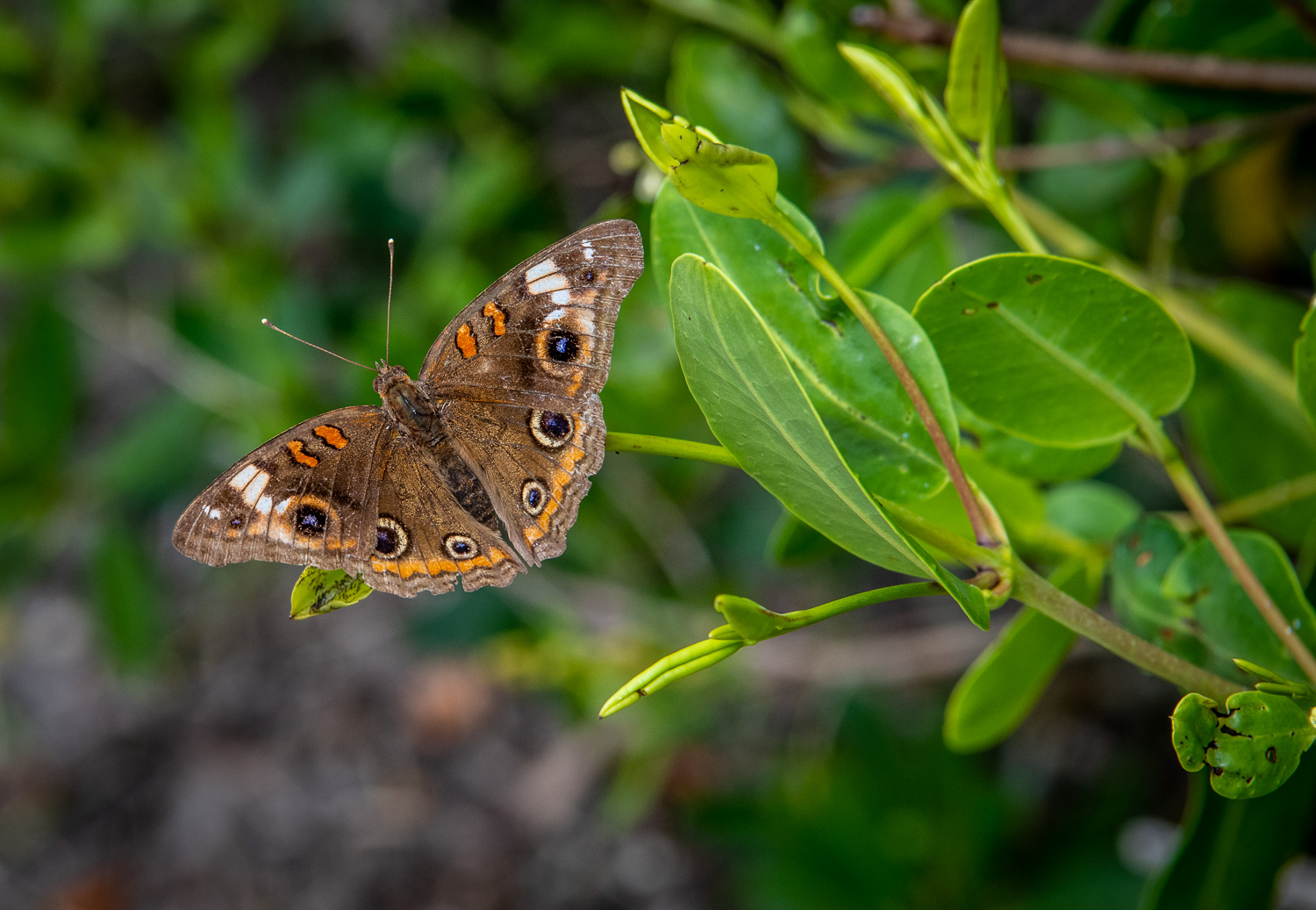
The entrance leads you into a native plant restoration garden, a vibrant patchwork of firebush, coontie, salvia, and dune sunflower. Butterflies flit like animated petals—zebra longwings drifting lazily, gulf fritillaries burning orange, cloudless sulphurs zipping past like neon-yellow comets.
I always pause here, partly to admire the artistry of the native plantings but mostly because a Florida naturalist is duty-bound to greet the butterflies, which serve as the park’s unofficial welcoming committee.
The Boardwalk: A Journey Through a Breathing Forest
Stepping onto the boardwalk feels like entering a sacred corridor. The air becomes more humid, more fragrant—the earthy scent of mangrove tannins layered over the salty breath of the bay.
And suddenly, you’re in it:
a cathedral of mangroves, their roots splayed like the ribbed legs of mythic beasts holding the world steady.
Red mangroves, with their arching prop roots, dominate the upper story, while black mangroves stand slightly inland, their pneumatophores rising like small brown candles from the mud. White mangroves appear farther from the water, broad-leaved and calm, as if observing the energetic red mangroves with wise amusement.
Mangroves always strike me as Florida’s quiet philosophers. They endure storms that would flatten lesser trees, tolerate salt that would poison most plants, and provide nurseries for thousands of marine species. In their stillness lies their power.
A gentle plunk breaks the silence—most likely a mullet, eternally confused and eternally jumping.
Wild Encounters Along the Mangrove Loop
Halfway through the loop, the wildlife becomes wonderfully apparent. As I lingered near the first overlook, a juvenile yellow-crowned night heron stared at me with the judgmental intensity only herons can muster.
Fiddler crabs scuttled across the mud using their oversized claw like tiny fiddles or oversized egos. A school of needlefish hovered in the shallows, each one a silver ribbon of concentrated purpose. Above, an osprey circled with the gravity of a monarch overseeing its tidal kingdom.
But the highlight—every time—comes from the soundscape.
You hear:
- The liquid chirr of clapper rails hiding in the reeds
- The metallic chatter of kingfishers
- The ping-pong ricochet call of wading herons
- The gentle whisper of mangrove leaves
In this place, you don’t just observe nature. You eavesdrop on it.
Reaching the Bay: A View Worth the Pilgrimage
The boardwalk eventually brings you to a wide wooden Bayfront Platform, one of the most peaceful lookout points on Longboat Key. As the view widens, Sarasota Bay stretches out like a sheet of hammered silver. Sailboats drift silently. Pelicans patrol the sky like airborne submarines.
I’ve watched dolphins pass this overlook more than once. Their movements are so fluid that the water seems to rearrange itself willingly around them.
A snowy egret stalks the shallows, every step a careful punctuation mark. Behind me, an osprey lets loose a piercing call—its nest perched atop a man-made platform built for exactly this purpose.
Joan M. Durante Park is not just a place to walk. It is a place to observe, to learn, and to allow yourself to become porous to the rhythms of the estuary.
The Tidal Lagoon: A World Within a World
The Tidal Lagoon Loop is one of the park’s most underrated treasures. The lagoon itself is a brackish cradle—a mixing bowl where freshwater runoff blends with the bay’s salty tide, creating a habitat unlike anything else.
Look down carefully into the shallow water and you may spot:
- Minnows schooling in tight, glittering clouds
- Horseshoe crab tracks etched in the mud
- Mangrove snails spiraling upward on trunks like tiny, slow climbers
This is the nursery of nurseries. If mangroves are the protectors of the shoreline, the lagoon is the nursery where the next generation of fish and crustaceans find their footing (or fins).
A pair of white ibis probe the edge of the water with the elegance of practiced foragers. Their curved red bills tap the mud rhythmically. I lean in closer and feel, for a moment, like I’ve slipped into a living watercolor painting.
Flora and Fauna of Joan M. Durante Park
Field notes for the curious wanderer
Birds
- Osprey
- Great blue heron
- Snowy egret
- Tricolored heron
- Yellow-crowned night heron
- White ibis
- Belted kingfisher
- Mourning dove
- Red-winged blackbird
- Clapper rail
- Northern cardinal
- Boat-tailed grackle
Mammals
- Raccoon
- Marsh rabbit
- Dolphin (offshore)
Reptiles & Amphibians
- Green anole
- Brown anole
- Yellow rat snake
- Peninsula cooter
- Mangrove tree crab
- Southern toad
Butterflies
- Zebra longwing
- Gulf fritillary
- Monarch
- Queen
- Cloudless sulphur
- Atala (occasional)
Marine & Estuary Life
- Needlefish
- Mullet
- Blue crab
- Horseshoe crab
- Snapping shrimp
- Oyster clusters
- Fiddler crab
Plants & Trees
- Red mangrove
- Black mangrove
- White mangrove
- Buttonwood
- Sabal palm
- Sea grape
- Firebush
- Coontie
- Dune sunflower
- Yaupon holly
- Wax myrtle
- Gumbo-limbo
- Spanish moss (technically a bromeliad!)
A Naturalist’s Reflection: The Gift of Restoration
Joan M. Durante Park wasn’t always like this. It was once a damaged parcel—strangled by invasives, cluttered with debris, and cut off from the natural flow of the bay. But thanks to a careful restoration project in the 1990s, involving scientists, volunteers, and the vision of Joan M. Durante herself, the land was coaxed back to life.
Today, the mangroves thrive again. The lagoon breathes again. The birds returned. The fish came home.
And every trail-walker, every child holding a seashell like a treasure, every naturalist bending down to admire a fiddler crab—they are all participating in the ongoing miracle of renewal.
Ending the Journey: Leaving Without Letting Go
As I exit the boardwalk and return to the sunshine near the parking lot, I feel that strange, sweet ache that comes from leaving a place that has opened something in you. Joan M. Durante Park is more than a preserve. It is an invitation—a gentle reminder that healing is possible, for landscapes and people alike.
Before starting my car, I always take one last breath of that mangrove-air. It smells like salt, earth, life, and the promise of tides that keep returning.
And so will I.
.