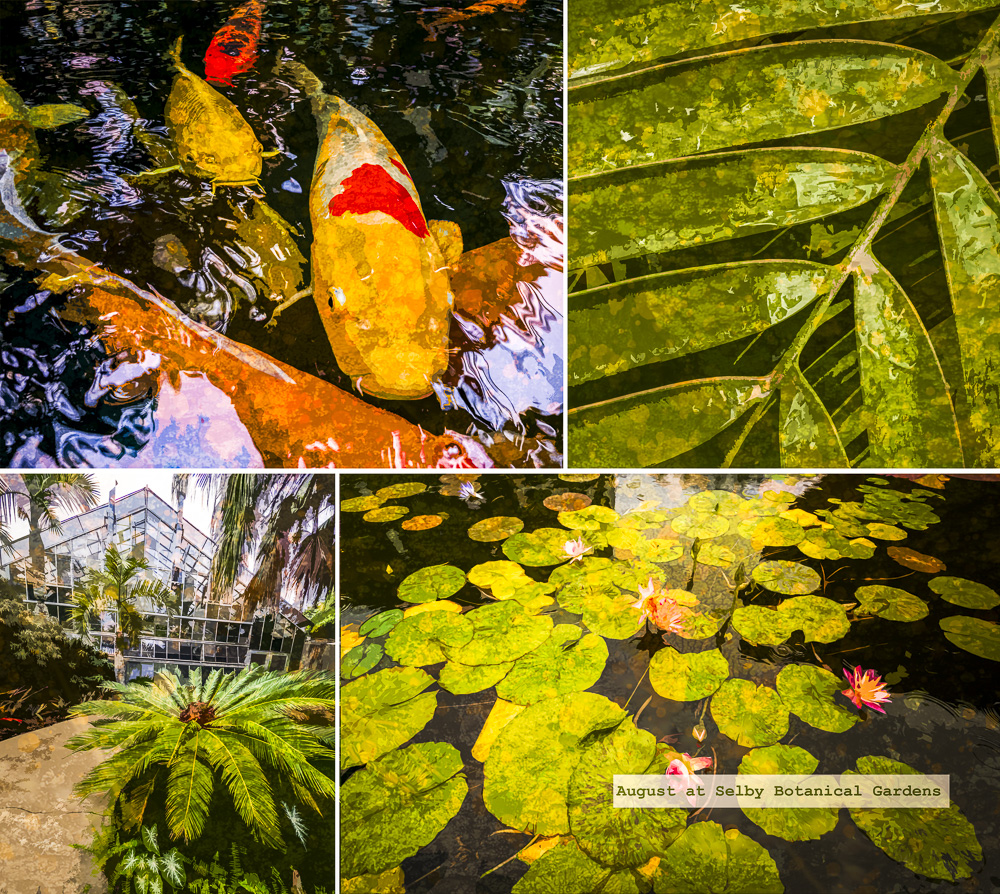
On mornings when Sarasota feels like a luminous shell just lifted from the Gulf, I point my compass toward the bayfront and step into Selby Botanical Gardens the way a man steps into a tidepool—slowly, reverently, ready to be surprised by what the water has been tending all night. Even before the gate closes behind me, the city’s hum has softened to a hush. There is the click of a brown anole on a wooden rail, the thin zipper of a palm warbler making quick work of scale insects, and the felt hush—a green hush—that only a garden of living, breathing archives can keep.
Selby, if you haven’t met her, is an epiphyte’s cathedral. Orchids, bromeliads, ferns, and their kin—plants that put their trust not in soil but in air, bark, and patience—have been curated here with the same meticulous love a librarian reserves for rare folios. The paths are bright glyphs that promise a sentence you can read with your body. I enter beneath the royal palms as if walking under punctuation—upright exclamation marks—while the bay flashes in facets through the leaves. The tide is slack, the mangroves hold their composure, and the whole place smells faintly of salt, humus, and anticipation.
To be a naturalist in a place like Selby is to practice two kinds of seeing at once. There is the looking that takes in the obvious: pink-sleeved bougainvillea, the thick gleam of philodendron, the improbable geometry of a bromeliad rosette holding a cup of rain. Then there is the looking that waits: the patience that lets the perching lizards reveal their territorial push-ups, that allows the squirrel treefrog to appear as a green comma on a leaf, that hears a mangrove skipper long before its wings carve the light. Gardens reward the second kind of seeing. Selby insists on it.
The first epiphyte I visit is an orchid with a flower like a small lantern—cream and maroon, freckled, and cunningly shaped. I lean in as if accepting a whispered secret and the flower obliges with a faint spice. Epiphytes make the most of their rented rooms. They gather mist and debris; they host microcosms in their leaf axils. Peer into a bromeliad tank and you’ll find the whole grammar of a forest writ small: mosquito larvae sailing like punctuation; a water beetle tracing clauses; rotifers—a thousand transparent hoop dancers—writing invisible poems. These “tanks” are rain reservoirs, yes, but they are also nursery, pantry, and parliament for creatures who have learned to trust a cup of rain held aloft.
One of Selby’s quiet miracles is that it’s as much a research institution as a promenade. In the herbarium, presses and cabinets hold stories flattened but still alive. A leaf becomes evidence. A flower becomes a testimony to what bloomed where, and when, and with whom. It comforts me, this sense that the beauty out here on the paths is underwritten by scholarship behind closed doors. The world is changing—fretting, warming, rearranging its furniture—and the meticulous record-keeping of botanists may prove to be the field notes that help us make the next right move.
But I promised an entertaining walk, not a manifesto, and Selby delivers. Near the banyan—the size of a remembered cathedral—I watch a toddler develop a theology of roots: he walks to one aerial root and hugs it, then to another, so thorough in his benedictions that his mother stops fretting and simply watches. Strangler figs and banyans do not care about our categories. They live by a slow confidence: a seed lands high, makes a modest living, sends roots down like ropes, thickens its intentions, and one day the host is more memory than matter. At Selby, the banyan is not a parable about conquest but a study in interdependence and time. There is room beneath its green vault for lovers to whisper and for herons to pass overhead like articulated punctuation.
The koi pond is a percussion section of mouths. I stand at the rail and test my reflection. A green anole—one of the true natives, unlike the brown interlopers—watches me with old-Florida suspicion, dewlap ready to flare if I lean too close. This is what I love about gardens that are not merely decorative: they are vessels where the spontaneous resists the planned. An orchid in a mount may be a planned sentence, but the lizard that perches there, the dragonfly that uses its spike as a launch pad, the sudden thrum of a cicada in the shade of a palm, these are the footnotes that make the text sing.
Just beyond the palms the mangroves hold the shore like careful hands. Red mangroves, with their arching prop roots, are architects of edges; black mangroves, with their pencil-thin pneumatophores, are the choir of breathers; white mangroves, often understated, are the diplomat siblings. All are boundary keepers. They sieve silt, soften waves, and offer nurseries for things we love to watch and love to eat. A school of juvenile snook flickers in the shallows. A tri-colored heron leans into itself, rehearsing the poem of stillness. When the wind turns, the bay carries something wild and ion-bright up the slope, and for a moment the city behind the garden seems to be an idea more than a place.
A pair of ospreys keens from a snag near the shoreline and the whole garden pauses to listen—at least that’s how it feels. One osprey drops, wings cupped, a parabola of intention. When it rises with a mullet, head forward, tail aft, the fish already oriented for flight, there’s a cheer from the boardwalk that makes the bird briefly mortal again. We are a species that claps for its food chain, and I love that about us. A child asks me if ospreys are eagles and I say they are cousins, fish-eagles of a kind, and the child nods with the grave courtesy reserved for uncles and aunts who live near water.
Inside the conservatory—humid with purpose—Selby gets intimate. If the outdoor gardens are prose, this glasshouse is a sonnet cycle. The air is curated to suit leaf and root. Drip lines tick; a fan turns with patient conviction; somewhere a misting nozzle hisses like a librarian asking for quiet. There are orchids here with lips the color of warning flags, orchids painted like tigers avoiding paparazzi, orchids that smell of night and improbable fruit. One has a spur so long it makes me think of Darwin and his hawkmoth: the way a flower can prophesy a pollinator and be right. Natural history is full of wagers like that—nature betting on reach and touch, on timing and fit. We are always, as observers, a little late to the punchline and grateful nevertheless.
I kneel beside a staghorn fern mounted like an antlered saint and run a finger along its shield frond. The plant feels like soft leather, and the impulse to genuflect is strong. Epiphytes grow where other plants would refuse a lease. They make soil out of leaf fall and hope. They do not parasitize; they borrow elevation and turn light into sugar without theft. As a naturalist, I admire that ethic. As an artist, I envy the design: all that negative space, all that sculptural restraint. If modern architecture had chloroplasts it might look like this.
At the far end of the conservatory, a display explains how some orchids trick their pollinators. Pseudocopulation, the text says with scientific decorum. The flower mimics the female insect—her shape, her scent—and the male arrives expecting romance and leaves carrying pollen, dazed and useful. There’s something hilarious and tender in that. The world is full of honest frauds, and every living thing is trying to place its small bet against oblivion. If this is manipulation, it’s also choreography. The bee gets his dance. The flower gets her future. The garden gets a new story to tell a passing child.
Outside again, the palms scribe shadows like musical staffs across the lawn, and I find my way to a bench that has known many backs. A zebra longwing saunters by in that unhurried heliconian way, tasting the air with its feet. In Florida, this butterfly is a minor celebrity, a black-and-creamy reminder that elegance can be a daily occurrence. I’ve watched zebra longwings roost, dozens at a time, each night returning to the same shrub like parishioners. Here, one flirts with a passionflower vine; the vine does what vines do, reaching for its next sentence, and I think about how many love stories are really about scaffolding and reach.
Selby is no stranger to spectacle—special exhibits, horticultural theater, flower shows that turn the conservatory into a dream you can walk inside—but the quiet, quotidian moments are what advocate for the place most persuasively. A red-shouldered hawk rides a thermal over the banyan, and his shadow braids the light. The clatter you hear is not traffic but the collective gossip of grackles. Even the maintenance routines feel like part of the rhythm: a gardener with a bucket squats beside a bromeliad, fingertips gentle as a surgeon, removing a leaf that’s declined its invitation to remain. It’s not that decay isn’t welcome here; it’s that even decay gets a curated role.
There is a section where medicinal and culinary plants are labeled with small signs that confess what humans have asked of them: heal a liver, sweeten a tea, clarify a soup, ease a heart. Gardens like this one remind us how long we’ve been in conversation with plants. We think of “green space” as respite or backdrop, but the greener truth is that we live inside a negotiation—a treaty signed and re-signed in sugars, oxygen, and pollen. Standing under a clump of bamboo, I listen to the trunks creak and remember that even silence has a working vocabulary.
Sometimes, when the afternoon gets glossy and the bay brightens like a blade, I drift toward the Payne Mansion, that old white sentinel that anchors the downtown campus like bone under skin. On days when an exhibit spills its imagination across those rooms, you can watch art and botany exchange vows. A Victorian herbarium draws breath beside a modern installation; a 19th-century explorer’s field sketch meets a digital scan of a living orchid. The present is hybrid here, and the future is a graft we are still learning to nurture.
If you want a lesson plan for joy, try this: sit at the edge of the mangroves as the tide changes. Watch the blue crabs debate whether your shadow is a hawk. Count mullet. Allow your breathing to match the water. Then rise and walk through the cycads as if every one of them is keeping a secret (many are). Note how the spiral of a cycad cone rhymes with the spiral of a conch and a hurricane and the galaxy you believe is indifferent to you. Remind yourself that patterns are the local dialect of awe. Selby is fluent.
I sometimes bring a notebook and make the kind of lists that never end: things that smell like pepper (bay leaves, crushed), sounds like glass (anole claws on a railing), things that pretend not to be magic (photosynthesis). The act of writing slows me enough to notice that the air plants in the live oak are throwing a quiet party—Tillandsia usneoides draping like a soft prophecy, T. recurvata dotting the branches like punctuation. Because Florida is Florida, a mockingbird practices his stand-up routine from the roofline: titmouse, car alarm, flirtatious creak of a gate, the exact beep of a crosswalk, each stolen and made new. It’s hard not to grin when the whole world is a sampler and still the sum is itself.
What Selby gives a naturalist is not merely identification—though the labels are a generosity—it gives permission to ask better questions. Which pollinators come to which orchids at what hour? How does a bromeliad adjust its chemistry to make a decent rain barrel without rotting? What happens to the detritus in an epiphyte cradle during a dry spell? Where do the green anoles survive the winter in a city that never quite decides to be cold? These questions are fieldwork prompts hidden in plain sight. They retrieve a beginner’s mind we forget to carry.
Late afternoon, the light goes honey-soft and the shadows pull long threads across the lawn. I have learned to linger for this. The air unbuttons. People slow, less urgent, more porous. Grown men become birders without noticing. Couples decide to speak more quietly. The garden becomes the kind of room where confidences feel safe: that is how evening works among plants—it is an architecture of consent. On the bay, a pelican executes a dive as tidy as punctuation at the end of a paragraph we didn’t know we were writing together.
When I finally walk toward the exit, the city’s skyline makes itself known again, but I am altered in the way a shoreline is altered by a tide: the same pattern, perhaps, but with new ripples, different gloss, a little more readiness to host what the next hour might set down. I think about the research collections asleep in their cabinets, about the gardeners who will arrive tomorrow with coffee and resolve, about the bromeliads holding tiny weather systems you can cup in two hands, about the ospreys who have the good manners to fish where people can see, and the black mangrove roots that keep breathing even when we forget to notice.
Selby Botanical Gardens—green museum, working studio, quiet chapel—reminds me that our best stories are not solitary. They are collaborations with the rooted and the winged. To walk here is to be added to a sentence that began long before you and will not end when you turn for home. It is to be drafted, gently, into a chorus that sings of lift and leaf, of water held and released, of time kept patient in shade. It is to join, as witness and participant, the daily liturgy of a place where the air is busy with meaning.
I step back onto the Sarasota sidewalk carrying the faint perfume of orchids and the practical salt of the bay, and I promise myself I will return soon with more questions and fewer names. Between the street and the garden, I pause for a moment and listen, because if you have learned anything at Selby you have learned this: the world drafts miracles in lowercase, and if you are still, they will sign their names on the wind.