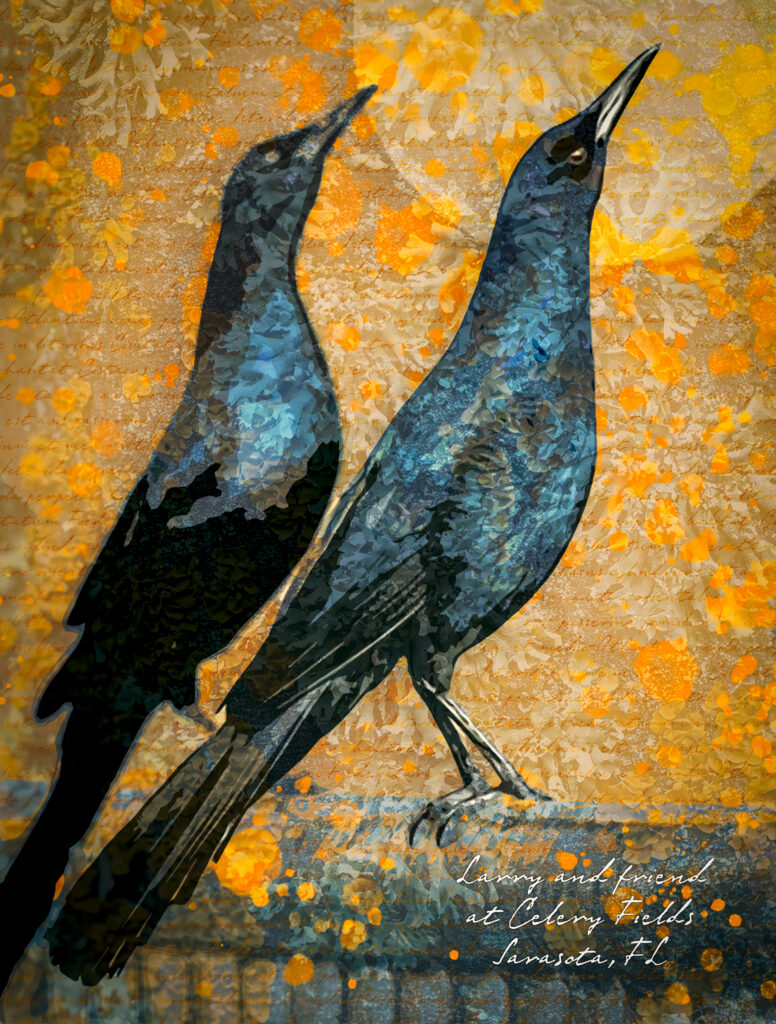
If you spend any amount of time in Florida with your eyes open and your ears unguarded, you will eventually encounter the boat-tailed grackle. You may first notice it as a sound rather than a sight—a metallic skree, a liquid creak, or what can only be described as a rusty gate being opened by a jazz musician with attitude. Then you’ll see it: glossy black, long-legged, cocky, and entirely unashamed of its presence. The grackle does not ask permission to be noticed. It assumes, quite reasonably in its own mind, that you were waiting for it.

From the standpoint of a naturalist, the boat-tailed grackle is one of Florida’s most revealing birds. It tells us stories not just about marshes and mangroves, but about parking lots, seawalls, shrimp boats, and outdoor cafés. It is a bird that thrives in the spaces where wild Florida and human Florida overlap—and occasionally collide.
A First Impression: Swagger With Feathers
The male boat-tailed grackle is hard to miss. He is large for a songbird, with an impossibly long tail that folds into a keel shape when closed, giving the species its nautical name. In the right light, his feathers shimmer with blues, purples, and oily greens, like spilled motor oil turned into art. His pale yellow eye, sharp against the dark plumage, gives him a look of constant appraisal—What are you doing, and can it benefit me?
The female is another story entirely. She is smaller, brown, and streaked, with a dark eye and a subtler presence. Early naturalists once assumed males and females were different species, which feels like an understandable mistake. Sexual dimorphism rarely goes this far. Together, they make a pair that looks mismatched until you realize that each embodies a different survival strategy: flamboyance and discretion, bravado and efficiency.
A Voice Like No Other
The boat-tailed grackle’s voice is not conventionally beautiful, but it is endlessly interesting. Its calls range from squeaks and clicks to whistles and grinding croaks. If most songbirds aim for melody, the grackle goes for texture. It sounds like it’s experimenting, improvising, trying things out just to see what happens.
From a naturalist’s perspective, this vocal diversity makes sense. Grackles are social birds, often gathering in loose colonies or large communal roosts. Their calls are not serenades meant for romantic evenings but tools for negotiation—about food, space, mates, and status. Listen closely and you can almost hear the conversations: That shrimp is mine. You’re too close. Look at me. Did you see that?
Born of Marsh and Tide
Unlike its close relative, the common grackle, the boat-tailed grackle is a bird of the coast. It is deeply tied to saltwater marshes, mangrove edges, tidal flats, and estuaries. Florida, with its vast shoreline and brackish ecosystems, is prime grackle country.
In a natural marsh, you’ll see grackles stalking fiddler crabs, probing mud for invertebrates, or perching on reeds to survey the tidal buffet below. They understand the rhythm of water rising and falling. Low tide reveals food; high tide invites rest and observation. This tidal awareness is a kind of ecological intelligence, passed down not in words but in behavior.
Opportunists Extraordinaire
Yet the true genius of the boat-tailed grackle lies in its adaptability. Where there are people, there are opportunities—and the grackle knows this. Parking lots become hunting grounds. Outdoor restaurants become experimental foraging zones. Boat ramps and fish cleaning stations are, to a grackle, nothing short of providential.
I have watched grackles learn the precise timing of a seafood restaurant’s lunch rush, arriving just as plates appear and diners look away. I have seen them pry open sugar packets, dunk French fries in puddles, and boldly inspect unattended bags. This is not mindless scavenging; it is problem-solving in real time.
As a naturalist, I can’t help but admire this. The grackle is not nostalgic for a lost wilderness. It is engaged with the world as it is.
Social Life of a Feathered Urbanite
Boat-tailed grackles are rarely alone. They gather in groups that can range from a few individuals to hundreds, especially outside the breeding season. At dusk, their communal roosts can be spectacular—trees vibrating with sound and movement as birds settle in, negotiate perches, and exchange the day’s gossip.
These roosts are not random. They are carefully chosen for safety, proximity to food, and thermal advantage. Mangroves, palms, and even urban trees can serve the purpose. In these gatherings, hierarchy matters. Dominant males claim the best spots. Younger or subordinate birds make do with the edges.
Watch long enough and patterns emerge. Certain birds are bolder, more aggressive. Others are cautious observers. It is impossible not to see personality here, even if science prefers more neutral language.
Courtship, Florida-Style
Breeding season brings out the grackle’s theatrical side. Males puff up their feathers, fan their tails, and deliver a repertoire of calls that seem designed to impress through sheer confidence. The display is less about beauty than assertion: I am here. I am strong. I have chosen this place.
Females are unimpressed by bluster alone. They choose nesting sites carefully, often in dense vegetation over water—marsh grasses, mangroves, or shrubs that offer protection from predators. Nests are messy affairs, woven from grasses, reeds, and whatever materials are at hand. Elegance is not the goal. Security is.
Ecological Role: Messy but Meaningful
Boat-tailed grackles sometimes get a bad reputation. They are accused of stealing food, bullying other birds, and being generally unruly. All of this is true, and yet it misses the larger picture.
Grackles are important predators of insects and crustaceans. They help control populations of pests in marshes and urban areas alike. Their scavenging accelerates nutrient cycling. Their presence indicates healthy coastal ecosystems capable of supporting complex food webs.
From a naturalist’s point of view, a landscape without grackles would be a quieter, poorer place—less dynamic, less honest about the intersections between nature and culture.
A Mirror of Florida Itself
Florida is a place of edges: land and water, wild and developed, ancient and newly paved. The boat-tailed grackle thrives precisely in these margins. It is neither purely wild nor fully domesticated. It is opportunistic without being dependent, bold without being tame.
In this way, the grackle feels like a mirror of Florida’s own character—flashy, adaptable, occasionally abrasive, and impossible to ignore. It does not retreat from human presence; it engages it. Sometimes it even outwits us.
Learning to See the Grackle
To really appreciate boat-tailed grackles, you have to slow down and watch. Notice how they walk rather than hop, their long legs giving them a strutting gait. Watch how they tilt their heads when inspecting something new. Listen for the subtle differences in their calls, the way sound changes with context.
As a naturalist, I’ve learned that the most familiar species often have the most to teach us. The grackle asks us to reconsider our ideas of beauty, value, and wildness. It challenges the notion that nature belongs only in pristine places.
Closing Thoughts From the Marsh Edge
The next time a boat-tailed grackle lands near your table, eyeing your lunch with what feels like personal interest, resist the urge to dismiss it as a nuisance. You are in the presence of a highly successful coastal strategist, a bird shaped by tides, trash cans, mangroves, and human forgetfulness.
In its glossy feathers and unapologetic voice is a lesson Florida keeps trying to teach us: survival favors those who pay attention, adapt quickly, and aren’t afraid to be a little loud about who they are.
And no bird embodies that lesson quite like the boat-tailed grackle.
| Boat-tailed grackle | |
|---|---|
 | |
| Breeding Male | |
 | |
| Female | |
Scientific classification  | |
| Kingdom: | Animalia |
| Phylum: | Chordata |
| Class: | Aves |
| Order: | Passeriformes |
| Family: | Icteridae |
| Genus: | Quiscalus |
| Species: | Q. major |
| Binomial name | |
| Quiscalus major Vieillot, 1819 | |
 | |
| Range of Q. major Year-round range Wintering range | |

The boat-tailed grackle (Quiscalus major) is a passerine bird of the family Icteridae found as a permanent resident on the coasts of the Southeastern and Mid-Atlantic United States.
Habitat
The boat-tailed grackle is found in coastal saltwater marshes and across the Florida peninsula.[2] In salt marsh areas, least bitterns will often associate with and make mixed colonies with grackles.[3] Boat-tailed grackles have established significant populations in several United States Gulf Coast cities and towns, using human activity as protection against predation and scavenging through human trash. Urban boat-tailed grackle populations can be found foraging in trash bins, parking lots, and outdoor restaurant patios.[4]
Breeding
The nest is a well-concealed cup in trees and shrubs near water; the average clutch size is just over three eggs.[5]
Male boat-tailed grackles compete to defend and mate with a harem of closely nesting females, although DNA evidence shows that females often successfully mate with other males while away from their colony, with only about a quarter of the young being fathered by the dominant male.[4]
Description
The male boat-tailed grackle is 37–43 cm (15–17 in) long and weighs 165–250 g (5.8–8.8 oz).[6] Adult males have entirely iridescent black plumage, a long dark bill, a pale yellowish or brown iris, and a long keel-shaped tail. The adult female is much smaller at 26–33 cm (10–13 in) long and a weight of 90–115 g (3.2–4.1 oz).[7] She is also distinguished by her shorter tail and tawny-brown coloration, which covers the body apart from the darker wings and tail. The wingspan in adult birds is 39–50 cm (15–20 in).[8] In standard measurements, this species measures 13–20 cm (5.1–7.9 in) along the wing bone, 11–20 cm (4.3–7.9 in) in tail length, 2–4.2 cm (0.79–1.65 in) along the culmen, and 3.6–5.8 cm (1.4–2.3 in) along the tarsus.[9] On average, the boat-tailed grackle weighs about 10% more than the closely related great-tailed grackle, although the male great-tailed grackle has an even longer tail.[9][10]
Young males are black but lack the adult's iridescence. Immature females are duller versions of the adult female and have blotches or spots on the breast. The eye color of the boat-tailed grackle varies with range. Gulf Coast and inland birds have dark eyes, whereas Atlantic birds have pale eyes.[11]

Taxonomy
The boat-tailed grackle was first described by French naturalist Louis Pierre Vieillot in 1819. Its specific epithet major means "larger" in Latin. Despite its restricted range, there are four subspecies of the boat-tailed grackle, differing in size and iris color. The boat-tailed grackle was once considered the same species as the great-tailed grackle. The great-tailed species is generally quite similar of slightly smaller body size but has a longer tail and lacks this species' distinct domed head shape. The common grackle, with which the boat-tailed species often overlaps along the Atlantic coastline, is noticeably smaller and shorter-tailed, as well as lacking the domed head shape. [citation needed]
Diet
They forage on the ground, in shallow water, or in shrubs; they will steal food from other birds, animals, or humans. They are omnivorous opportunistic feeders, eating insects, crustaceans, minnows, frogs, eggs, berries, seeds, grain, and even small birds.[2]
Call
Its song is a harsh jeeb, and it has a variety of typically grackle-like chatters and squeaks. Their call lacks of whistles and clucks typical of the great-tailed grackle.[12]
Gallery
 Male vocalizing on Sanibel Island, Florida
 Female at Rodanthe Public Beach, North Carolina
 Male at Deerfield Beach, Florida
 A gathering of Grackles at Winding Waters Nature Area, Florida


References
- ↑ BirdLife International (2025). "Quiscalus major". IUCN Red List of Threatened Species. 2025 e.T22724311A136662294. doi:10.2305/IUCN.UK.2025-2.RLTS.T22724311A136662294.en.
- 1 2 "Boat-tailed Grackle Life History, All About Birds, Cornell Lab of Ornithology". www.allaboutbirds.org. Retrieved 2025-01-23.
- ↑ Post, William; Seals, Carol A. (1993). "Nesting Associations of Least Bitterns and Boat-Tailed Grackles". The Condor. 95 (1): 139–144. doi:10.2307/1369395. JSTOR 1369395.
- 1 2 "Boat-tailed Grackle Overview, All About Birds, Cornell Lab of Ornithology". www.allaboutbirds.org. Retrieved 2025-07-03.
- ↑ Tutor, Billy M. (1962). "Nesting Studies of the Boat-tailed Grackle". The Auk. 79 (1): 77–84. doi:10.2307/4082451. JSTOR 4082451.
- ↑ "FieldGuides: Species Detail". eNature. Archived from the original on 23 June 2013. Retrieved 5 March 2013.
- ↑ Bancroft, G.T. (1984). "Growth and sexual dimorphism of the Boat-tailed Grackle" (PDF). Condor. 86 (4): 423–432. doi:10.2307/1366822. JSTOR 1366822.
- ↑ "Boat-tailed Grackle". All About Birds. Cornell Lab of Ornithology. Retrieved 5 March 2013. "Boat-tailed Grackle, Life History, All About Birds – Cornell Lab of Ornithology". Allaboutbirds.org. Retrieved 2013-03-05.
- 1 2 Jaramillo, Alvaro; Burke, Peter (1999). New World Blackbirds: The Icterids. Christopher Helm Publishing. ISBN 978-0-7136-4333-6.
- ↑ Dunning Jr., John B., ed. (1992). CRC Handbook of Avian Body Masses. CRC Press. ISBN 978-0-8493-4258-5.
- ↑ "Grackles – Are you getting them right?". eBird.org.
- ↑ "Boat-tailed Grackle | Audubon Field Guide". www.audubon.org. Retrieved 2025-07-03.
External links
- Boat-tailed grackle at Florida Bird Sounds (Florida Museum of Natural History)
- BirdLife species factsheet for Quiscalus major
- "Quiscalus major". Avibase.
- "Boat-tailed grackle media". Internet Bird Collection.
- Boat-tailed grackle photo gallery at VIREO (Drexel University)
- Interactive range map of Quiscalus major at IUCN Red List
- Audio recordings of Boat-tailed grackle on Xeno-canto.
- Citizen science observations for Boat-tailed grackle at iNaturalist
