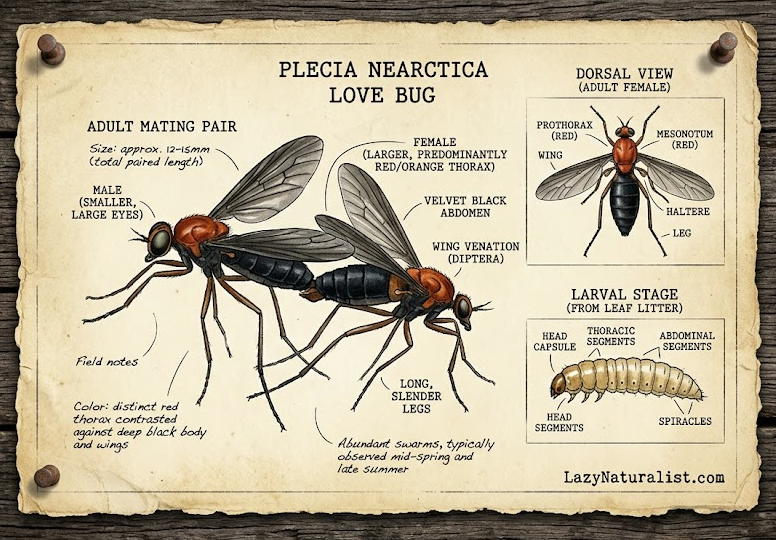
The Love Bug (Plecia nearctica) is a small, distinctively colored species of march fly native to parts of Central America and the southeastern United States, most famously associated with Florida and the Gulf Coast. Known for their sudden, massive population explosions and their habit of flying in locked pairs, these insects are a staple of regional folklore and driver frustration.
Key Facts Profile – Plecia nearctica
Family – Bibionidae (March flies)
Appearance – Small, slender black bodies with a bright reddish-orange thorax (the midsection behind the head).
Size – Approximately 1/4 inch (6 mm) to 1/3 inch (9 mm) in length; females are noticeably larger than males.
Habitat – Grassy areas, pastures, roadsides, and decaying organic matter across the Gulf Coast region.
Flight Seasons – Two distinct annual emergences lasting about 4–5 weeks each: April–May and August–September.
Most Interesting Things
1. They Aren’t Actually Bugs
Despite their common name, love bugs are true flies (Diptera), not true bugs (Hemiptera). They belong to the march fly family. They do not bite, sting, transmit human diseases, or consume crops.
2. The “University of Florida Experiment” is a Total Myth
A widespread urban legend claims that love bugs were genetically engineered in a University of Florida lab in the 1950s or 60s to control mosquito populations, and accidentally escaped. In reality, they are a entirely natural species that migrated organically from Central America into Texas and Louisiana, eventually reaching Florida by the late 1940s.
3. They are Attracted to Highways by Physics and Chemistry
Love bugs swarm near major roads because they are highly attracted to automobile exhaust, engine heat, and the vibration of passing cars. The UV radiation from sunlight reacting with exhaust fumes creates chemical compounds that mimic the odors of decaying organic matter, which love bugs naturally seek out for egg-laying.
4. Their Splattered Remains Can Destroy Car Paint
While completely harmless to humans, love bugs are a major headache for motorists. When they splatter onto a vehicle, their body fluids are slightly acidic ($pH \approx 6.5$). If left baked on a car bumper or hood under the hot sun for more than 24 to 48 hours, the fluids undergo chemical decomposition, etching the paint and causing permanent pitting.
5. They Clog Radiators and Cause Engines to Overheat
During peak swarms, the sheer volume of bugs can completely coat a vehicle’s front grille. If enough of them are drawn into the radiator fins, they can block airflow entirely, leading to sudden engine overheating. Many regional drivers use “bug screens” or apply a light layer of baby oil or cooking spray to the bumper to make post-drive cleanup easier.
6. Their “Love” Flight Lasts for Days
The name “love bug” comes from their unique mating ritual. Males form swarms over pastures just after dawn, waiting for emerging females. Once a male hooks up with a female, they lock together tail-to-tail and remain coupled for up to three to five days—even while flying, feeding on flower nectar, and resting. The larger female typically does the heavy lifting, steering the pair through the air.
7. They Have an Incredibly Short Adult Lifespan
An adult love bug’s entire existence is focused purely on reproduction. After spending months underground as larvae, adults emerge, mate, lay eggs, and die within just a few days. Males generally live for about 2 to 3 days, while females live for up to a week.
8. They are Essential Ecological Recyclers
Though universally annoyed by their seasonal swarms, humans benefit greatly from love bug larvae. The immature insects live just beneath the soil surface in pastures and roadsides, where they feed exclusively on decaying thatch, grass clippings, and organic debris. They act as vital natural decomposers, recycling nutrients back into the soil.
| Lovebug | |
|---|---|

| |
| Two lovebugs mating | |
Scientific classification 
| |
| Kingdom: | Animalia |
| Phylum: | Arthropoda |
| Clade: | Pancrustacea |
| Class: | Insecta |
| Order: | Diptera |
| Family: | Bibionidae |
| Genus: | Plecia |
| Species: | P. nearctica
|
| Binomial name | |
| Plecia nearctica | |
The lovebug (Plecia nearctica) is a species of march fly found in parts of Central America and the southeastern United States, especially along the Gulf Coast.[2] It is also known as the honeymoon fly or double-headed bug. During and after mating, mature pairs remain together, even in flight, for up to several days.[3]
The species was first described in 1940 by D. E. Hardy, though it had been observed in Louisiana as early as 1911.[4] At the time, Hardy reported the distribution of lovebugs to be widespread, but more common in Texas and Louisiana than other Gulf States.[2] By the end of the 20th century, the species had spread to all areas bordering the Gulf of Mexico, the entirety of Florida, and had spread as far as Georgia and South Carolina. L. A. Hetrick, writing in 1970, found the bug was also widespread in central and northern Florida and described its flights as reaching altitudes of 300 to 450 meters (980 to 1,480 ft) and extending several kilometers over the Gulf.[5]
Lovebug larvae feed on partially decayed vegetation in the landscape and, in this respect, are beneficial to humans. Adults primarily feed on nectar from various plants, particularly sweet clover, goldenrod, and Brazilian pepper.[2] The lovebug is considered a nuisance by many motorists, especially in the state of Florida, due to its swarming behavior during the species' mating season.[6]
Semi-annual pest status

Male/female pairs (joined tail-to-tail) will hover in the air, drifting slowly. Two major flights occur each year; the spring flight occurs during late April and May, and the summer flight occurs during late August and September. Flights extend over periods of four to five weeks.[5][7][8] In South Florida, a third (but smaller) flight can occur in December.[2] Mating takes place almost immediately after the emergence of the females. Adult females live only three to four days, while males live a little longer. They have to stick to each other at all times.[2]
This species' reputation as a public nuisance is due not to any bite or sting (it is incapable of either), but to its slightly acidic body chemistry. There are no health risks to humans, as disease cannot be transmitted through them.[9] Because airborne lovebugs can exist in enormous numbers near highways, they die in large numbers on automobile windshields, hoods, and radiator grilles when vehicles travel at highway speeds. If left for more than an hour or two, the remains become extremely difficult to remove. Their body chemistry has a nearly neutral 6.5 pH but may become acidic at 4.25 pH if left on the car for a day.[2] In the past, the acidity of the dead adult body, especially the female's egg masses, often resulted in pits and etches in automotive paint and chrome if not quickly removed.[10] However, advances in automotive paints and protective coatings have reduced this threat significantly. Now the greatest concern is excessive clogging of vehicle radiator air passages by the bodies of the adults, with a reduction of the cooling effect on engines, and the obstruction of windshields when the remains of the adults and egg masses are smeared on the glass.[2]
Lovebug adults are attracted to light-colored surfaces, especially if they are freshly painted, but adults congregate almost anywhere, apparently reacting to the effects of sunlight on automobile fumes, asphalt, and other products affected by environmental factors still not completely understood.[2]
Folklore
Research by L.L. Buschman showed that migration explained the introduction of the lovebug into Florida and other southeastern states, contrary to the urban myth that the University of Florida created them by manipulating DNA to control mosquito populations.[3]
Much speculation about the lovebug still thrives. This is partly because the larval form of this insect is seldom seen, as it lives and feeds in the thatch of grasses for most of the year. While various fungi are suspected of being natural controls for this species,[2] biological control of these non-pest flies is not a priority for funding.
Management
Lovebugs are subject to some significant natural controls, such as various parasitic fungi,[2] and dry weather, which dries out the thatch, resulting in a higher mortality rate for the immature. As the lovebug migrated around the Gulf Coast, first to Texas, then Louisiana, then further eastward, the initial populations for many years were so excessive that they caused public concern and initiated rumors of their origin. However, as pest populations migrate naturally, their natural controls are usually not far behind. While it often took decades, lovebug flights are no longer present in the huge numbers that once existed simply because their natural controls (mostly fungi) caught up with established populations. In many areas, local lovebug flights may only be present in excessively large numbers due to occasional local conditions that may not be repeated in successive years.
While lovebugs are not a favored food of most insectivores due to their acidic taste, lovebug larvae—and some adults—are food for birds such as quail and robins. Arthropod predators include spiders, some predatory insects such as earwigs, at least two species of beetle larvae, and centipedes.[10]
Life cycle
Female lovebugs can lay as many as 350 eggs and regularly lay these eggs around decaying material on the top layer of ground soil.[11] Lovebug eggs generally hatch after 2–4 days, depending on the flight season. Once the eggs have hatched, the larvae start feeding on the decaying material around them, such as decaying plants on the soil and other organic material, and live and remain in the soil until they develop to the pupa stage.[11] During the warmer months the lovebug larvae remain in the larvae phase for approximately 120 days and approximately 240 days during the cooler months.[12] Lovebugs typically stay in the pupa stage about 7–9 days before reaching the adult phase, in which they can start reproducing.[13]
Once adults, lovebugs are ready to start copulating to begin reproducing. Adult male lovebugs emerge first from the pupal stage and hover around until female lovebugs emerge.[14] Mating between lovebugs takes place immediately after the emergence of the adult females.[15] A male lovebug copulates and will remain paired up until the female has been fully fertilized. Copulation takes place for 2–3 days before the female detaches, lays her eggs, and dies. Adult females have been recorded to live up to seven days, while adult males may live up to two to five days, but on average, lovebugs live three to four days.[16] However, Thornhill (1976c) recorded recapture data that showed males lived longer in the field than females.[2]
References
- ^ Hardy, D. Elmo (1940). "Studies in New World Plecia (Bibionidae: Diptera)". Journal of the Kansas Entomological Society. 13 (1). Kansas: Kansas (Central States) Entomological Society: 15–27. JSTOR 25081585.
- ^ a b c d e f g h i j k Denmark, Harold; Mead, Frank; Fasulo, Thomas (April 2010). "Lovebug, Plecia nearctica Hardy". Featured Creatures. University of Florida/IFAS. Retrieved 22 September 2010.
- ^ a b Leppla, Norman (September 2009). "Living with lovebugs". Electronic Data Information Source of UF/IFAS Extension. Institute of Food and Agricultural Sciences, University of Florida. Retrieved 23 September 2010.
- ^ Buschman, Lawrent L. (June 1976). "Invasion of Florida by the "Lovebug" Plecia Nearctica (Diptera: Bibionidae)" (PDF). Florida Entomologist. 59 (2). Florida Entomological Society: 191–194. doi:10.2307/3493971. JSTOR 3493971. Retrieved 8 February 2016.
- ^ a b Hetrick, L. (March 1970). "Biology of the 'love-bug', (Diptera: Bibionidae)" (PDF). Florida Entomologist. 53. Entomological Society of Florida: 23–26. doi:10.2307/3493110. JSTOR 3493110. Retrieved 23 September 2008.
- ^ "Love bugs 'worst in 20 years' say car washes who are ringing up the business". The News-Press. Retrieved 2023-08-04.
- ^ Cherry, R., and Raid, R. 2000. Seasonal flight of Plecia nearctica (Diptera: Bibionidae) in southern Florida. Florida Entomol. 83: 94–96.
- ^ Denmark, H. A., and F. W. Mead. "Lovebug - Plecia Nearctica Hardy." Lovebug – Plecia Nearctica Hardy. DPI Entomology Circular 350, 15 Aug. 1998. Web. 24 July 2014.
- ^ "Dreaded lovebugs are back, swarming cars. What you should know about the invasive species". USA Today.
- ^ a b Weston, J.; Short, Donald E.; Pfiester, M. (8 February 2022) [Originally published October 1993 in Pests in and around the Florida Home]. "Lovebugs in Florida". Electronic Data Information Source of UF/IFAS Extension. Institute of Food and Agricultural Sciences, University of Florida. Publication No. ENY-329. Retrieved 2 September 2024.
- ^ a b Wenston, J., D. E. Short, and M. Pfiester. "Lovebugs in Florida." EDIS New Publications RSS. University of Florida, 2013. Web. 25 July 2014.
- ^ Leppla, Norman C. "Living With Lovebugs." EDIS New Publications RSS. University of Florida/IFAS Extension, 15 Jan. 2007. Web. 24 July 2014
- ^ Hetrick LA. 1970a. Biology of the "love-bug," Plecia nearctica (Diptera: Bibionidae). Florida Entomologist 53: 23-26.
- ^ Thornhill, Randy. "Dispersal of Plecia Nearctica (Diptera: Bibionidae)." The Florida Entomologist 57.1 (1980): 45. ProQuest. Web. 24 July 2014.
- ^ Thornhill, R. 1976c. Reproductive behavior of the lovebug, Plecia nearctica (Diptera: Bibionidae). Ann. Entomol. Soc. Amer. 69:843-847
- ^ Hieber, C., J. Cohen. 1983. Sexual Selection in the Lovebug, *Plecia nearctica*: The role of male choice. Evolution, 37(5): 987-992.
