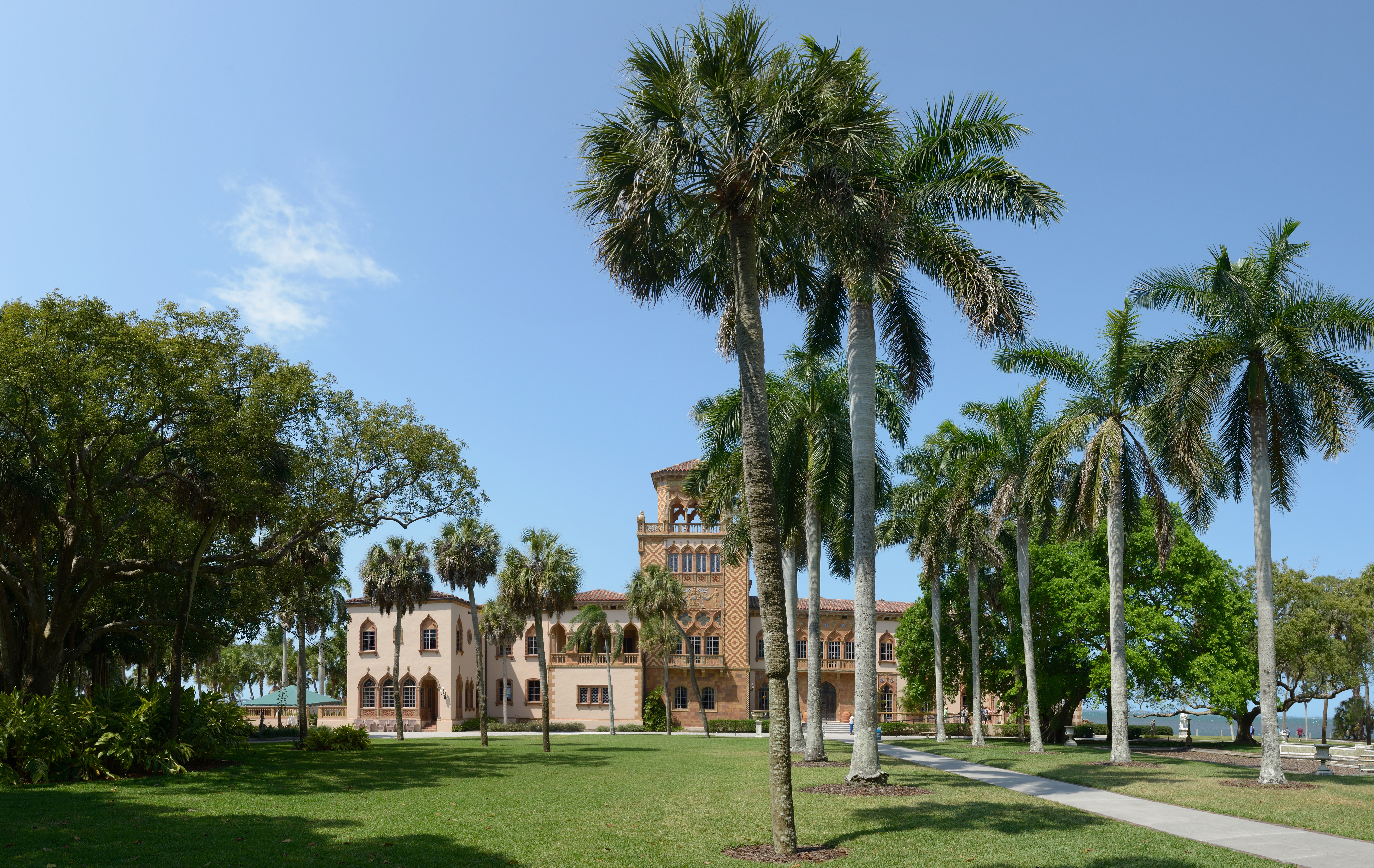
There are days when I walk into a place in Florida and feel—before even seeing anything—that the land has something to show me. Not merely a display or an exhibition, but a conversation, a story waiting in a shadow, a rustle, a shaft of light.
The Ringling Museum Grounds in Sarasota—John and Mable Ringling’s sprawling Mediterranean fantasy on the bay—are one of those sacred geographic intersections where culture, nature, architecture, and sea breeze weave into a single, shimmering tapestry.
Most visitors come for the art, the circus history, the Ca’ d’Zan mansion, the galleries packed with Rubens and Baroque angels. But step outside, onto the walkways, gardens, and bayfront paths, and you discover a different kind of museum: a living one, curated by wind, tide, and the wild persistence of Florida flora.
This is that story—from a naturalist’s eyes.
Getting There: A Pilgrimage Through Sarasota’s Coastal Corridor
Reaching the Ringling estate isn’t difficult—but arriving with the right mindset makes all the difference.
From Downtown Sarasota:
Take U.S. 41 North (Tamiami Trail), hugging the bay as it opens into a widening sheet of silver. Pass the Van Wezel, the purple seashell of a theater, and continue north. Just past the University Parkway intersection, a right turn at 5401 Bay Shore Road delivers you into another world: banyans, palms, and Mediterranean arches.
From Bradenton, Palmetto, or I-275:
Head south on U.S. 41, cross the sweeping bridges at the mouth of the Manatee River, and continue until Bay Shore Road appears on your left. Turn, breathe, and let the pace slow.
Trust me:
The moment you enter the shaded canopy of Bay Shore Road—one of Sarasota’s most beautiful historic streets—you’ll feel the temperature drop and the world shift.
It’s the herald of a good day.
The Top Eight Features of the Grounds
(A naturalist’s ranking, biased heavily toward hawks, trees, and salt air.)
1. The Ca’ d’Zan Bayfront & Terrace
If the Ringling estate has a heartbeat, it pulses here—where Sarasota Bay kisses the marble terrace of the Ca’ d’Zan, the Ringlings’ elaborate Venetian-style mansion.
For a naturalist, this is a perfect merging of human craftsmanship and the wild.
Stand at the water’s edge and watch:
- cownose rays drifting like winged shadows,
- dolphins slicing through the surface with a quiet exhalation,
- pelicans folding themselves into dive-bombs like prehistoric arrows.
In winter, the afternoon sun turns the estate peach and gold; in summer, thunderstorms roll across the bay like a cosmic pageant.
2. The Banyan Groves: Living Cathedrals
The banyan trees (Ficus benghalensis) at the Ringling grounds are not merely plants—they are architects of wonder. Their aerial roots cascade like natural pillars, creating walkways that feel like hallways in an otherworldly temple.
John Ringling collected exotic trees almost the way he collected circus acts—with spectacle in mind. Some of these banyans were planted from saplings gifted by Thomas Edison himself.
Stand still for a moment:
- Cardinals flicker in scarlet
- Squirrels perform acrobatics that would’ve impressed any circus
- The filtered light dances on the leaf-litter floor
It’s an auditorium of soft green light.
3. The Secret Path by the Rose Garden
Many visitors focus on the roses themselves—hundreds of cultivars blooming in spirals, circles, and geometric beds. But the naturalist in me prefers the quiet path behind the garden, where the gravel crunches underfoot and the smell of roses blends with oak, loam, and sun-warmed grass.
Here is where you’ll see:
- Gulf fritillary butterflies spiraling courtship dances
- Black-and-white warblers “creeping” along the oak trunks
- Brown anoles puffing their orange dewlaps in territorial bravado
Roses may be the stars, but the supporting cast of wild Florida is exceptional.
4. The Museum Courtyards & Classical Gardens
Step into the courtyard of the Museum of Art, and you’re suddenly in a Renaissance dreamscape—pink arcades, marble columns, and the iconic replica of Michelangelo’s David standing sentinel.
Yet even here, nature insists on participating:
- Mockingbirds nest in the shrubbery along the balustrades
- Lizards sun themselves on terracotta steps
- Vultures soar high above the statues like guardians of the skies
The Ringlings may have imported Europe, but Florida still holds the deed.
5. The Dwarf Garden: A Whimsical Corner of History
John and Mable had a fondness for the fantastical. The Dwarf Garden, filled with whimsical statues of dwarves recreated from a European original, is a playful spot often overlooked.
For naturalists, it’s a great place to observe:
- blue-gray gnatcatchers in ceaseless motion,
- tufted titmice hopping from branch to branch,
- bees browsing the nearby ornamental plantings.
Even stone figures attract life.
6. The Bolger Campiello and Waterfront Steps
Just north of the Ca’ d’Zan lies a modern addition: a sweeping bayfront lawn and terrace with clean lines and open views. Naturalists and birders love this area for its unobstructed sky—an ideal place to spot:
- osprey riding thermals
- frigatebirds (rare but possible on windy days)
- migrating hawks in fall
Bring binoculars, watch the horizon, and let the Gulf Coast’s raptors do the rest.
7. The Circus Museum Grounds
Here, the echoes of Sarasota’s circus history mingle with the calls of grackles and the rustling of cabbage palms. The outdoor grounds of the Circus Museum offer a surprising blend of nostalgia and ecology.
Walk past vintage wagons and posters, and you’ll see:
- great-crested flycatchers
- red-bellied woodpeckers
- rabbit families nibbling clover around the exhibits
The circus once brought exotic animals; today the local wildlife performs for free.
8. The Nature Nooks Along Bay Shore Road
Before leaving, wander back along Bay Shore Road itself. This shaded street—one of the most beautiful in Sarasota—is lined with old oaks, banyans, and lush tropical landscaping.
In the early morning or just before dusk, you can catch:
- barred owls calling “who cooks for you?”
- coy squirrels stashing acorns
- the occasional bobcat slipping silently across driveways (rare, but it happens)
This quiet corridor invites you to slow down, breathe deeper, and leave changed.
A Florida Naturalist’s Field Notes: Flora & Fauna of the Ringling Grounds
Because no naturalist leaves home without a notebook—or at least a mental list.
Flora (Native & Introduced)
Trees & Palms
- Banyan (Ficus benghalensis)
- Live oak (Quercus virginiana)
- Sabal palm (Sabal palmetto – native and iconic)
- Royal palm (Roystonea regia)
- Bottlebrush tree
- Gumbo-limbo (Bursera simaruba)
- Southern magnolia (Magnolia grandiflora)
Flowering Plants & Shrubs
- Roses (many cultivars)
- Bird of paradise
- Bougainvillea
- Hibiscus
- Firebush (Hamelia patens – excellent for butterflies)
- Coontie (Zamia integrifolia – host plant for the Atala butterfly)
- Muhly grass (Muhlenbergia capillaris)
Aquatic & Bayfront Vegetation
- Mangrove seedlings (occasionally seen along riprap)
- Seagrasses offshore (turtle grass, manatee grass)
Fauna (A Naturalist’s Sightings List)
Birds
- Osprey
- Brown pelican
- Great blue heron
- Snowy egret
- Tri-colored heron
- Anhinga
- Red-shouldered hawk
- Fish crow
- Northern mockingbird
- Cardinal
- Mourning dove
- Blue jay
- Black vulture & turkey vulture
- Belted kingfisher (often wintering on the bayfront)
- Yellow-crowned night heron (especially near dusk)
Butterflies
- Zebra longwing
- Monarch
- Gulf fritillary
- Pipevine swallowtail
- Atala (if coontie is present—watch for its orange spots)
Reptiles & Amphibians
- Brown anole
- Green anole (if you’re lucky)
- Peninsula cooter (near ponds)
- Red-eared sliders (introduced, but present)
Mammals
- Eastern gray squirrel (resident acrobat-in-chief)
- Raccoon (mostly nocturnal)
- Marsh rabbits
- Bobcat (elusive but occasionally sighted along Bay Shore)
Marine Life (viewed from bayfront)
- Bottlenose dolphins
- Cownose rays
- Needlefish
- Schools of mullet performing synchronized leaps
The Feel of the Place: A Naturalist’s Reflection
Walking the Ringling grounds is like drifting between worlds.
One moment you’re inside a European courtyard with marble angels; the next you’re under a banyan canopy older than the city itself; then you’re on a bayfront terrace where dolphins arc through sunlight like silver punctuation marks.
Few places in Florida capture the strange and beautiful blend of:
- natural splendor,
- cultural opulence, and
- wild persistence
quite the way the Ringling property does.
This land has seen circus kings, art collectors, and generations of Sarasota families strolling its walkways—but beneath all of it, Florida goes on being Florida:
Wind whispering in palm fronds.
An osprey’s whistle spiraling down from above.
A lizard sunning itself on a pink marble step.
Art may be eternal, but nature is continuous.
Leaving the Grounds, Carrying the Story
As I walked back to my car beneath the banyan arches of Bay Shore Road, a mockingbird sang a descant from somewhere deep inside the canopy. The late-afternoon light played on the mansion’s tiles, turning them gold.
I thought about John and Mable Ringling—how they built a world of spectacle, beauty, and performance—and just how gracefully nature has waltzed with their legacy.
The grounds are a reminder that in Florida, nature is never background décor.
It is the protagonist.
It is the narrator.
It is the reason we feel something sacred when we step under a banyan’s shadow or stand at the edge of Sarasota Bay breathing in the salt.
And as a naturalist, I always leave the Ringling estate with the same quiet certainty:
The greatest masterpiece here isn’t hanging in a gallery.
It’s growing, blooming, flying, diving, and singing all around us.