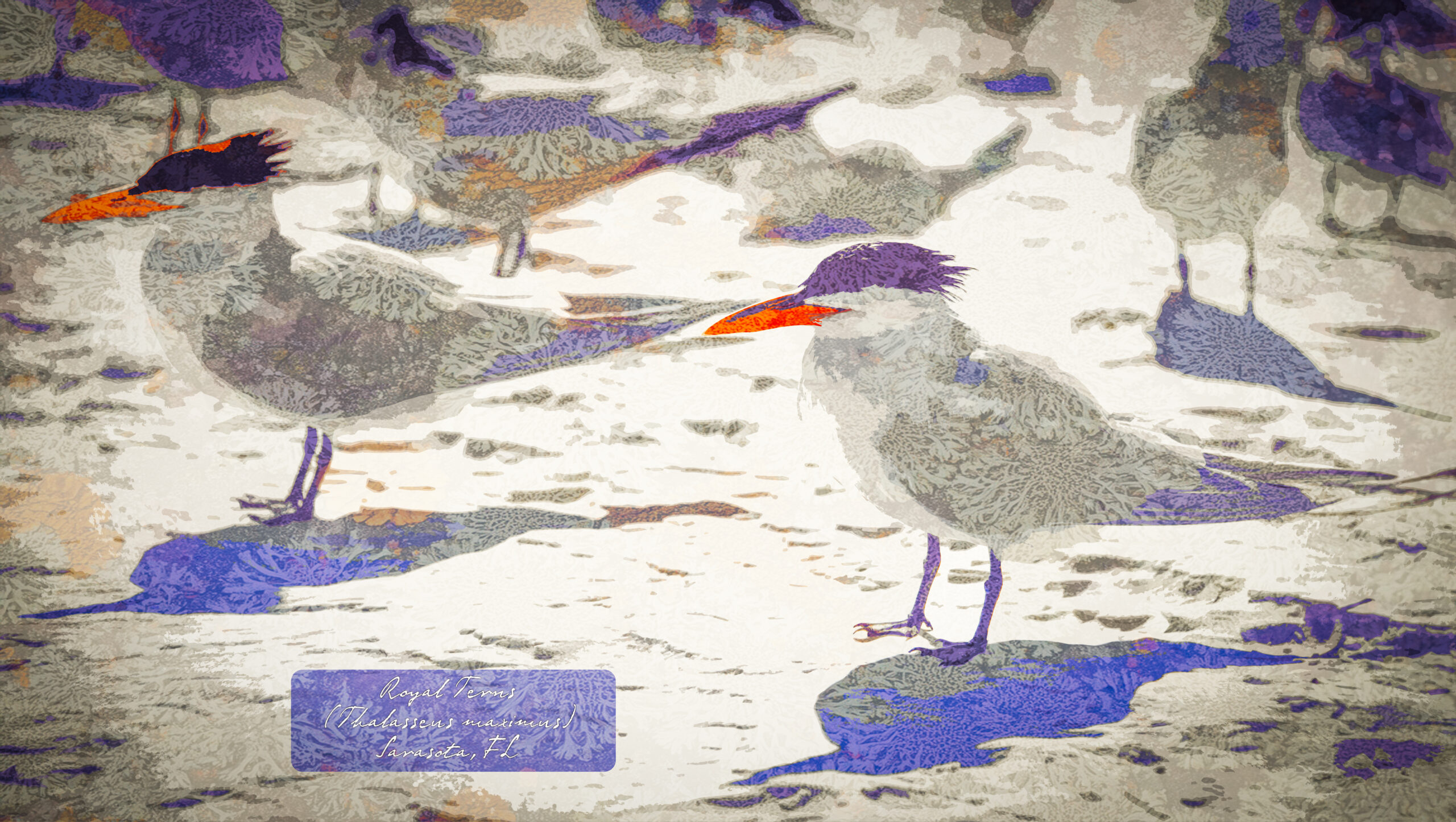
Standing on the quartz-white sands of Siesta Key or watching the sunset over Sarasota Bay, one cannot miss the loud, rhythmic “keary-keary” calls of the Royal Tern (Thalasseus maximus). With their shaggy black crests and dagger-like orange bills, these birds are as much a fixture of the Sarasota landscape as the palm trees and the Gulf of Mexico. While they may seem like common beach-goers, the Royal Tern is a master of the coastal environment, representing a delicate success story in Florida’s ongoing struggle for shorebird conservation.
Anatomy of a Coastal Monarch
The Royal Tern is a large, elegant seabird, second in size only to the Caspian Tern. To the untrained eye, they are easily confused, but the Royal Tern possesses a distinct silhouette. It is characterized by a pale gray back, white underparts, and long, pointed wings that span nearly 43 inches.
Key Identification Features
The Bill: A heavy, bright orange-to-reddish bill. Unlike the Caspian Tern, which has a darker, redder bill with a black tip, the Royal Tern’s bill is a cleaner, more carrot-like orange.
The Crest: During the breeding season, adults sport a solid black cap. However, for much of the year in Sarasota, you will see them with a “balding” appearance—the black cap recedes, leaving a white forehead and a shaggy black crest at the back of the head.
The Legs: Sturdy black legs and webbed feet, perfect for pivoting on shifting sands or launching into flight from a sandbar.
Life in Sarasota: Habitat and Range
In Sarasota, Royal Terns are year-round residents, though their local numbers swell in the winter as northern populations migrate south. They are strictly saltwater birds, rarely found more than a few miles inland unless a significant storm or hurricane pushes them toward the center of the state.
Prime Spotting Locations
If you are looking to observe these monarchs in their natural habitat, several Sarasota landmarks offer prime viewing:
Lido Key and Siesta Key: They are frequently seen resting in large “loafing” flocks on the shoreline, often huddling together against the wind.
Sarasota Bay Sandbars: During low tide, sandbars near the Ringling Causeway and Bird Key become bustling social hubs for Royal Terns and their cousins, the Sandwich Terns.
The Venice Inlet: The fast-moving waters of the inlet provide excellent foraging grounds where the birds can be seen plunge-diving for fish.
Foraging Behavior: The High-Dive Hunter
The Royal Tern is a spectacular hunter to watch. They feed primarily on small fish—such as menhaden, anchovies, and sardines—along with the occasional shrimp or blue crab.
The Hunt
Unlike gulls, which tend to scavenge, Royal Terns are specialized plunge-divers. They fly roughly 20 to 30 feet above the water’s surface, hovering momentarily when they spot a flash of silver. With a sudden tuck of their wings, they drop vertically, piercing the water with their bills. They emerge almost instantly, shaking the water from their feathers and swallowing their prey head-first while still in flight.
Breeding and the “Crèche” System
While Royal Terns are seen year-round in Sarasota, their nesting habits are a testament to the power of community. They are colonial nesters, meaning they gather in massive groups—sometimes numbering in the thousands—to raise their young.
The Sarasota Connection
Historically, Royal Terns nested on various islands along Florida’s Gulf Coast. Today, much of their nesting occurs on spoil islands—islands created by dredged sand—which provide a buffer from land-based predators like raccoons and feral cats. In recent years, local conservation groups like Sarasota Audubon have monitored nesting activity on nearby 3D Island and other protected shoals in the Tampa Bay and Sarasota regions.
Raising the Next Generation
A Royal Tern nest is a simple “scrape” in the sand. A single egg is laid, and both parents share incubation duties.
The Crèche: Within just a few days of hatching, the chicks leave their individual nests and gather in a large group called a crèche. This “daycare” system allows a few adults to guard hundreds of chicks against predators while the other parents are away fishing. Despite the chaos of thousands of birds, parents and chicks recognize each other’s unique vocal calls, ensuring every bird is fed by its own family.
Conservation Challenges in a Changing Florida
As of 2026, the Royal Tern is listed as a species of Least Concern globally, but in Florida, they face localized pressures that require constant vigilance.
Threats to the Species
Human Disturbance: Sarasota’s popularity as a tourist destination means more foot traffic on beaches. When humans or dogs run into a flock of resting terns, the birds waste vital energy reserves taking flight.
Sea Level Rise: Because they nest on low-lying islands and sandbars, Royal Tern colonies are highly vulnerable to “wash-outs” during high-tide events and tropical storms, which are becoming more frequent.
Plastic Pollution: Like many seabirds, Royal Terns can mistake plastic debris for food or become entangled in discarded fishing lines near Sarasota’s popular fishing piers.
How to Help
Sarasota residents and visitors play a crucial role in the survival of these birds. Conservationists recommend three simple rules:
Give them space: Stay at least 100 feet away from resting or nesting flocks.
Dispose of fishing line: Use the designated “monofilament” recycling bins found at local boat ramps and piers.
Respect “Closed” Signs: During nesting season (March through August), certain sandbars and island perimeters are roped off. These are Critical Wildlife Areas that provide the only safe haven for the next generation of terns.
Conclusion
The Royal Tern is more than just a background character in Sarasota’s coastal scenery; it is an indicator of the health of our estuaries and the success of our conservation efforts. To see a Royal Tern soaring over the Gulf, its orange bill glowing in the afternoon sun, is to see a species that has adapted perfectly to the edge of the world. By respecting their space and protecting their habitat, we ensure that their sharp, wild calls will continue to echo across Sarasota Bay for generations to come.