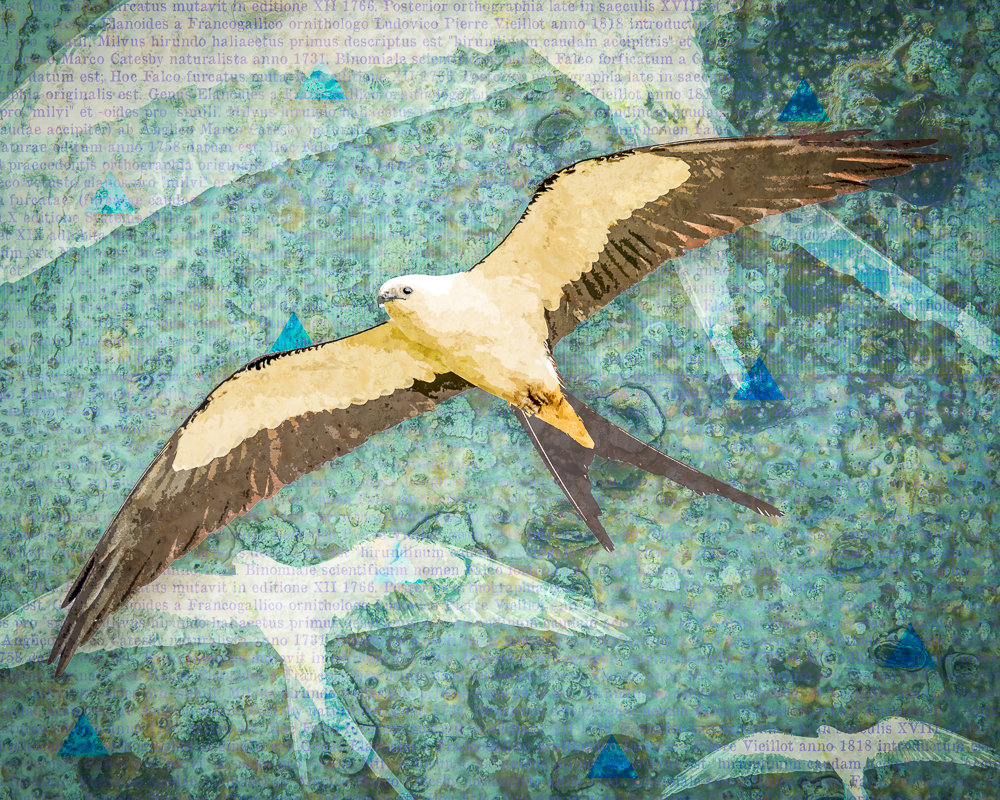
As a Florida certified master naturalist, I’ve had the privilege of observing and studying the magnificent Swallow-tailed kite for many years. This truly remarkable bird is one of the true gems of the Sunshine State’s diverse avian population. With its striking black and white plumage, deeply forked tail, and effortless aerial maneuvers, the Swallow-tailed kite captivates all who are lucky enough to witness its breathtaking aerial displays.
The Swallow-tailed kite (Elanoides forficatus) is a raptor, but it is unlike any other hawk or eagle you’ll find in Florida. It belongs to the kite family, a group of raptors known for their exceptional flying abilities and unique hunting strategies. While most hawks and eagles rely on powerful wing beats to soar and dive after prey, the Swallow-tailed kite is a true master of the skies, using its long, slender wings and deeply forked tail to perform aerial acrobatics that are simply unmatched.
These magnificent birds spend the majority of their lives in the air, gracefully gliding and soaring on thermals and updrafts, occasionally flapping their wings to maintain momentum. They are capable of executing tight turns, steep dives, and even flying upside down as they hunt for their preferred prey of insects, small reptiles, and nestling birds. Their flight is so effortless and elegant that it’s often been described as a captivating aerial dance.
The Swallow-tailed kite’s range extends across the southeastern United States, with the largest breeding population found in Florida. Every spring, these birds return to the Sunshine State after spending the winter months in South America, arriving in late February or early March. Their return is a highly anticipated event for birdwatchers and nature enthusiasts alike, as it signals the start of another season of awe-inspiring aerial displays.
One of the best places to observe Swallow-tailed kites in Florida is in the state’s extensive network of protected wetlands and forests. These birds thrive in areas with a mix of open habitats, such as marshes and prairies, and forested areas, where they can find suitable nesting sites and abundant prey. The Everglades, Okefenokee Swamp, and various state and national parks across the state are all excellent locations to witness the Swallow-tailed kite’s captivating aerial performances.
As a master naturalist, I’ve had the privilege of leading numerous guided tours and educational programs focused on these remarkable birds. One of my favorite experiences was leading a group of visitors on a swamp tour in the Everglades. As we glided silently through the serene waterways, surrounded by the lush, verdant vegetation, a pair of Swallow-tailed kites suddenly appeared overhead, effortlessly soaring and diving, their long, forked tails cutting through the air like graceful scimitars.
The group was spellbound, their eyes fixed on the birds as they executed one breathtaking maneuver after another. At one point, the kites began to spiral upwards, riding the thermals and gaining altitude until they were mere specks against the brilliant blue sky. Then, without warning, they folded their wings and plummeted downwards, only to pull up at the last moment, their tails fanning out to arrest their descent. The collective gasp of awe from the group was music to my ears, as I knew they were witnessing something truly special – a glimpse into the extraordinary world of the Swallow-tailed kite.
These birds are not only captivating to observe, but they also play a crucial role in the delicate ecosystems of Florida. As top-level predators, Swallow-tailed kites help to maintain the balance of their prey populations, which include everything from snakes and lizards to small birds and insects. Their presence is a testament to the overall health and biodiversity of the habitats they inhabit, and their conservation is of paramount importance.
Unfortunately, the Swallow-tailed kite’s numbers have declined significantly over the past century, primarily due to habitat loss and degradation. As Florida’s population has grown and development has encroached on natural areas, the kites have been forced to adapt to an increasingly fragmented landscape. Additionally, the use of pesticides and other chemicals has had a detrimental impact on the availability of their prey, further threatening the species’ long-term survival.
In response to these challenges, conservation efforts have been implemented to protect the Swallow-tailed kite and its habitat. Organizations such as the Audubon Society, the Florida Fish and Wildlife Conservation Commission, and the U.S. Fish and Wildlife Service have worked tirelessly to establish protected areas, promote sustainable land management practices, and raise awareness about the importance of these remarkable birds.
As a master naturalist, I’m deeply committed to these conservation efforts, and I take every opportunity to educate the public about the Swallow-tailed kite and its role in the Florida ecosystem. Through guided tours, educational programs, and community outreach, I strive to inspire a sense of wonder and appreciation for these graceful aerial dancers, and to encourage everyone to play a part in ensuring their continued survival.
One of the most rewarding aspects of my work is witnessing the transformative effect that a close encounter with a Swallow-tailed kite can have on people. I’ll never forget the time I led a group of school children on a field trip to a local nature preserve. As we walked through the winding trails, suddenly a pair of kites appeared overhead, their distinctive silhouettes and forked tails immediately capturing the children’s attention.
At first, the kids were simply mesmerized, their eyes glued to the birds as they effortlessly glided and soared. But as I began to share information about the kites’ remarkable adaptations and the crucial role they play in the ecosystem, their fascination quickly turned to a deeper sense of wonder and appreciation. By the end of the day, the children were eager to learn more, and several of them expressed a desire to become junior naturalists themselves, inspired by the beauty and importance of the Swallow-tailed kite.
Moments like these are what make my work as a master naturalist so rewarding. Every time I have the opportunity to share my knowledge and passion for these incredible birds, I’m reminded of the power of nature to captivate, inspire, and transform. The Swallow-tailed kite is not just a beautiful creature – it’s a living embodiment of the delicate balance and intricate interconnectedness of our natural world, a symbol of the beauty and wonder that we must strive to protect for generations to come.
As I look to the future, I’m hopeful that the Swallow-tailed kite will continue to grace the skies of Florida for many years to come. With continued conservation efforts, education, and a deep appreciation for the natural world, I believe we can ensure that these magnificent birds will continue to thrill and inspire all who are lucky enough to witness their breathtaking aerial displays. And as a Florida certified master naturalist, I’ll continue to be a passionate advocate for the Swallow-tailed kite, sharing its story and advocating for its protection with every opportunity that arises.
| Swallow-tailed kite | |
|---|---|
.jpg)
| |
Scientific classification 
| |
| Kingdom: | Animalia |
| Phylum: | Chordata |
| Class: | Aves |
| Order: | Accipitriformes |
| Family: | Accipitridae |
| Genus: | Elanoides Vieillot, 1818 |
| Species: | E. forficatus
|
| Binomial name | |
| Elanoides forficatus | |
| Subspecies | |
| |

| |
| Distribution: Year-round Breeding Migration
| |
| Synonyms | |
|
Elanus forficatus (Linnaeus, 1758) | |

The swallow-tailed kite (Elanoides forficatus) is a pernine raptor which breeds from the southeastern United States to eastern Peru and northern Argentina. It is the only species in the genus Elanoides. Most North and Central American breeders winter in South America where the species is resident year round.
Taxonomy and systematics
The swallow-tailed kite was first described as the "swallow-tail hawk" and "accipiter cauda furcata" (forked-tail hawk) by the English naturalist Mark Catesby in 1731.[2] It was given the binomial scientific name Falco forficatus by Carl Linnaeus in the 10th edition of Systema Naturae, published in 1758;[3] he changed this to Falco furcatus in the 12th edition of 1766.[4] The latter spelling was used widely during the 18th and 19th centuries, but the original spelling has precedence. The genus Elanoides was introduced by the French ornithologist Louis Pierre Vieillot in 1818.[5][6] The name is from Ancient Greek elanos for "kite" and -oides for "resembling".[7]
Description
The species is 50 to 68 cm (20 to 27 in) in length, with a wingspan of approximately 1.12–1.36 m (3.7–4.5 ft). Male and female individuals appear similar. The body weight is 310–600 g (11–21 oz).[8][9] The body is a contrasting deep black and white. The flight feathers, tail, feet, bill are all black. Another characteristic is the elongated, forked tail at 27.5–37 cm (10.8–14.6 in) long, hence the name swallow-tailed. The wings are also relatively elongated, as the wing chord measures 39–45 cm (15–18 in). The tarsus is fairly short for the size of the bird at 3.3 cm (1.3 in).[10] The body is a contrasting deep black and white. The upper side of the wings is black along with the tail, feet, and bill. The underside of the wings is partly black and partly white.
Young swallow-tailed kites are duller in color than the adults, and the tail is not as deeply forked. Sometimes a high-pitched chirp is emitted, though the birds mostly remain silent.
Habitat and distribution

The swallow-tailed kite is largely associated with large tracts of wetland forests which accommodates the bird's nesting habits. Loblolly pines (Pinus taeda) are the most prevalent choice for building nests but bald cypress (Taxodium distichum) are also used when the pines are unavailable. The major requirement of these nesting sites are food availability and tree height. Nesting locations are often found in trees as high as 100 ft (30 m). Historic ranges in the United States covered the majority of the Southern states and much of the Midwest (in Kentucky, Indiana, Ohio, Illinois, Missouri, Iowa, Kansas, Nebraska, and as far north as Wisconsin and Minnesota).[11] Aside from the US, it resides in many areas throughout Central and South America. Habitat degradation and changes in wetland hydrology have caused the range to shrink in the US to just coastal regions of the southeastern and southwestern US, roughly an 80% decline in population.
Swallow-tailed kites are considered migratory raptors and during the spring months often move from areas in Central and South America to breed. Roughly 3% of the world's population breed in the United States.[12] Traveling thousands of miles these birds move towards the most suitable nesting habitat found within coastal wetlands between the Americas. Satellite-telemetry has allowed researchers to track movements of individual birds over the years and has yielded data that demonstrates some migration journeys longer than 10,000 mi (16,000 km). Land located within migration routes is thought to be another concern for the kites, as deforestation and habitat degradation in Central and South Americas can have adverse affects as the birds move to breed. The birds are considered one of the most graceful fliers seen in America and often spend the majority of their lives scouring high tree tops for lizards, small mammals, and insects. The morphology of the swallow-tailed kite's wing and tail structure allows the bird to glide effortlessly for long distances.[13][14][12]
Diet
The swallow-tailed kite feeds on small reptiles, such as snakes and lizards.[15] It may also feed on small amphibians such as frogs; large insects, such as grasshoppers, crickets, termites, ants, wasps, dragonflies, beetles, and caterpillars; small birds and their eggs and nestlings; and small mammals including bats.[16][17] It has also been known to prey on fish.[18] It has been observed to regularly consume fruit in Central America.[19] It drinks by skimming the surface and collecting water in its beak. The bird usually does not break flight during feeding.[8]
Reproduction
Mating occurs from March to May, with the female laying two to four eggs. They are white or bluish white, spotted with brown.[20] Incubation lasts 28 days, and 36 to 42 days to fledge. Often thought to form monogamous pairs, the birds are thought to spend some time apart and meet up during migrations to nesting locations. These nesting locations are often found in the highest trees in wetland areas.[8] On occasion, pairs will return to the same nesting locations of the previous years and refurbish old nests. Generally, nests take about four days to complete.[8]
Conservation in the United States

Swallow-tailed kites are not listed as endangered or threatened by the federal government in the United States as of 2024.[11][21] They are listed as endangered by the state of South Carolina[22] and as threatened by the state of Texas.[23] They are listed as "rare" by the state of Georgia.[21]
The Center for Birds of Prey in Charleston, South Carolina has an ongoing effort to track sightings within the state. Anonymous reports can be made at Swallow-tailed Kite Sighting Form or by telephone. They will also send you the summary of the years reported sightings if you leave them your contact information.

Destruction of habitats is chiefly responsible for the decline in numbers. A key conservation area is the Lower Suwannee National Wildlife Refuge in Florida. As of 2016, populations have seemed to stabilize and even show increasing trends.[citation needed] Successful habitat restoration and management has allowed these birds to reestablish nesting populations in areas of Georgia, Florida, and South Carolina.[citation needed]
References
- Sources
- Stiles and Skutch, A guide to the birds of Costa Rica ISBN 0-8014-9600-4
- Notes
- ^ BirdLife International (2016). "Elanoides forficatus". IUCN Red List of Threatened Species. 2016 e.T22695017A93484824. doi:10.2305/IUCN.UK.2016-3.RLTS.T22695017A93484824.en. Retrieved 13 November 2021.
- ^ Catesby, Mark (1731). "The swallow-tail hawk". The Natural History of Carolina, Florida and the Bahama Islands, Volume 1. Vol. 1. London. p. 4.
- ^ Linnæi, Caroli (1758). Systema Naturae per Regna Tria Naturæ, tome 1 (in Latin) (10th ed.). Holmiæ (Stockholm): Laurentii Salvii. p. 59. BHL / Missouri Botanical Garden
- ^ a Linné, Caroli (1766). Systema Naturae per Regna Tria Naturæ, tome 1 (in Latin) (12th ed.). Holmiæ (Stockholm): Laurentii Salvii. p. 129. BHL / Harvard University Botany Libraries
- ^ Vieillot, Louis Pierre (1818). Nouveau Dictionnaire d'Histoire Naturelle Appliquée aux Arts. Volume 24 (in French). Vol. 24. Paris: Chez Deterville. p. 101. doi:10.5962/bhl.title.20211.
- ^ Mayr, Ernst; Cottrell, G. William, eds. (1979). Check-list of Birds of the World. Volume 1. Vol. 1 (2nd ed.). Cambridge, Massachusetts: Museum of Comparative Zoology. p. 288.
- ^ Jobling, James A. (2010). The Helm Dictionary of Scientific Bird Names. London: Christopher Helm. p. 144. ISBN 978-1-4081-2501-4.
- ^ a b c d "Swallow-tailed Kite Life History, All About Birds, Cornell Lab of Ornithology". www.allaboutbirds.org. Retrieved 21 January 2024.
- ^ Clements, Kenny (2007). Encyclopedia of Birds. Facts On File, Incorporated. ISBN 978-1-4381-2998-3.
- ^ Raptors of the World by Ferguson-Lees, Christie, Franklin, Mead & Burton. Houghton Mifflin (2001), ISBN 0-618-12762-3
- ^ a b NatureServe (4 October 2024). "Elanoides forficatus". NatureServe Network Biodiversity Location Data accessed through NatureServe Explorer [web application]. Arlington, Virginia: NatureServe. Retrieved 22 October 2024.
- ^ a b "DSpace" (PDF). dc.statelibrary.sc.gov. Retrieved 21 January 2024.
- ^ "Swallow-tailed Kite Migration". Retrieved 21 January 2024.
- ^ "Swallow-tailed kite Habitat Requirements" (PDF). Archived from the original (PDF) on 4 October 2015. Retrieved 27 April 2018.
- ^ "Swallow-tailed Kite | Audubon Field Guide". Audubon. Retrieved 25 April 2024.
- ^ "Swallow-tailed Kite | the Peregrine Fund".
- ^ Ferguson-Lees, J. & Christie, D.A. & Franklin, K. & Mead, D. & Burton, P.. (2001). Raptors of the world. Helm Identification Guides.
- ^ "Elanoides forficatus (Swallow-tailed Kite)" (PDF). The Online Guide to the Animals of Trinidad and Tobago.
- ^ Buskirk, William; Margaret Lechner (October 1978). "Frugivory by Swallow-Tailed Kites in Costa Rica". The Auk. 95: 767–768.
- ^ "THE BIRD BOOK".
- ^ a b Williams, E.J.; Swan, D.; Schneider, T.M.; Keyes, T.S.; Day, A. (8 November 2019) [Originally compiled 1999]. "Elanoides forficatus (Linnaeus, 1758)". Georgia Biodiversity Portal. Retrieved 22 October 2024.
- ^ Wade, Ray (1 April 2017). "Swallow-tailed Kites". Endangered Species Articles. Photos by Harold Blackwood. South Carolina Wildlife Federation. Retrieved 22 October 2024.
- ^ "State-Listed Threatened Species in Texas" (PDF). Texas Secretary of State. 30 March 2020. 31 TAC §65.175. Retrieved 22 October 2024.
External links
- "American Swallow-tailed Kite media". Internet Bird Collection.
- 5 pictures of Swallow-tailed Kites at amazilia.net
- Stamps (for Grenadines of Guyana, Guyana, Nicaragua) with Range Map at bird-stamps.org
- Swallow-tailed Kite photo gallery at VIREO (Drexel University)
- Photo of soaring Swallow-tailed Kite at cayaya-birding.com
- Swallow-tailed Kite species account at Neotropical Birds (Cornell Lab of Ornithology)
- Interactive range map of Elanoides forficatus at IUCN Red List
- Illustration in Histoire naturelle des oiseaux de l'Amérique Septentrionale (1807).
- Description by Vieillot (1818) of Milan de la Caroline and Milan Yetapa du Paraguay, and the original designation of Elanoïdes (in French).
- Illustration in Lesson's Traite d'Ornithologie (1831).
- DSpace
| |||||||||||||||||
| |||||||||||||||||


