Big Flats in Myakka River State Park in May is the best and most memorable local display of Coreopsis.
In the world of plants and folklore, seeing Tickseed (Coreopsis) carries a variety of meanings, ranging from its botanical “message” to its historical symbolism in the language of flowers.
1. The Language of Flowers: “Always Cheerful”
In Victorian floriography, flowers were used to send coded messages. Because of its bright, sunny disposition and ability to bloom profusely even in tough conditions, Coreopsis traditionally symbolizes:
Cheerfulness and Optimism: It was often given to someone to say, “You are always cheerful.”
Love at First Sight: In some traditions, it represents the initial spark of attraction.
Enduring Happiness: Because many species are perennial and return year after year, it represents a steady, reliable joy.
2. The Naturalist’s Perspective: A Healthy Ecosystem
To a naturalist, seeing Tickseed is a sign of a thriving local environment. If you are spotting them in Florida, they tell a specific story:
A “State” of Beauty:Coreopsis is the Florida State Wildflower. Seeing it often means you are in a spot where native flora is being preserved or has successfully reseeded.
Pollinator Activity: If the flowers are in bloom, they are likely a hub for native bees and butterflies, particularly the Common Buckeye or various skipper butterflies.
Soil Indicators: Many varieties thrive in sandy, well-drained soil. Seeing a large patch usually indicates a sunny, open habitat like a pine flatwood or a roadside prairie.
3. Etymology: The “Bug” Connection
The name “Tickseed” isn’t as romantic as the flower looks! It comes from the Greek words koris (bug) and opsis (view/appearance). This refers to the small, dark seeds which look remarkably like ticks or beetles. In this sense, seeing the seed heads is a reminder of nature’s clever “hitchhiking” design for seed dispersal.
4. Cultural and Practical History
Dye Making: Historically, certain species of Coreopsis were used by Indigenous peoples and early settlers to create vibrant red and yellow dyes for textiles.
Stability: In the garden, seeing Tickseed means “low maintenance.” It is one of the hardier native plants, often used to signify a landscape that is both beautiful and drought-tolerant.
Whether you’re looking at them through the lens of an artist or a naturalist, they are essentially nature’s way of signaling resilience and bright energy.
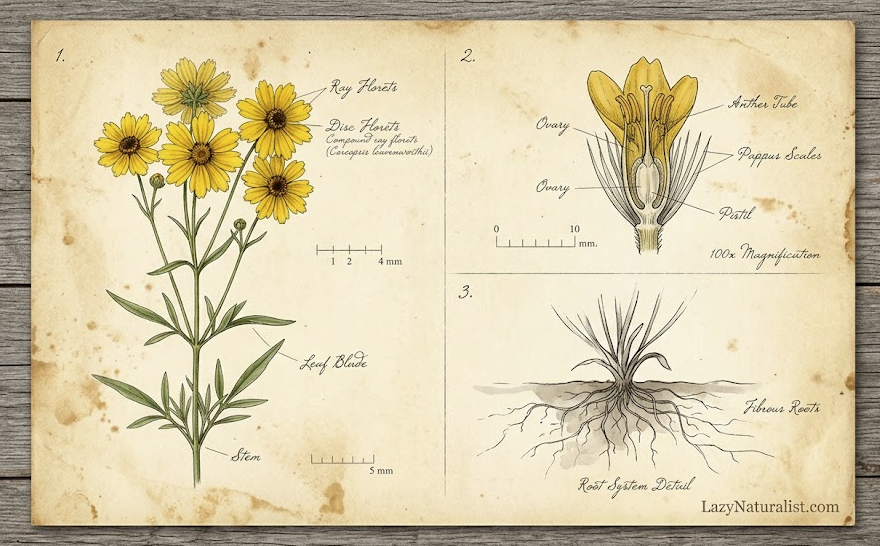
These plants range from 46–120 centimetres (18–47 inches) in height. The flowers are usually yellow with a toothed tip, but can also be yellow-and-red bicolor or pink.[3] They have showy flower heads with involucral bracts in two distinct series of eight each, the outer being commonly connate at the base. The flat fruits are small and dry and look like insects.
There are nearly 40 species of Coreopsis, all of which are native to North, Central, and South America.[1] The name Coreopsis is derived from the Ancient Greek words κόρις (transl.grc– transl.koris), meaning "bedbug", and ὄψις (transl.grc– transl.opsis), meaning "view", referring to the shape of the achene.[4][5]
Coreopsis is a variable genus closely related to Bidens. In fact, neither Coreopsis nor Bidens, as defined in the 20th century, is strictly monophyletic. Coreopsis is best described as paraphyletic. Previously (1936), Coreopsis was classified into 11 sections and 114 species, but the African species were subsequently reclassified as Bidens, leaving the North and South American species, some 75–80 in all, under Coreopsis. 45 species are in the 11 North American sections, and the remaining 35 are in the South American section Pseudoagarista. The North American species fall into two broad groups, with 5 sections and 12 species in Mexico and North America and the remaining 5 sections and 26 species in Eastern North America.[4]
Plants of the World Online accepts the genera AnacisSchrank,[8]ElectrantheraMesfin, D.J.Crawford & Pruski,[9]EpilepisBenth.,[10]LeptosyneDC.,[11] and Silphidium(Torr. & A.Gray) Mesfin & D.J.Crawford,[12] which other authorities, including the Global Compositae Database, treat as synonyms of Coreopsis. Plants of the World Online treats Selleophytum as a synonym of Coreopsis.[13]
North American Coreopsis can be found in two habitats in the wild, growing along roadsides and open fields throughout the Eastern United States and Canada. In this environment the plant will self-sow.
Coreopsis can grow in a garden as a border plant, or in a container, preferring well-drained soil. Deadheading the flowers ensures it does not become weedy. Using the U.S. Department of Agriculture (USDA) hardiness zones will identify what soil and climate is preferred for different cultivars or species.[16] Notable species found in cultivation are C.grandiflora and C.verticillata, as well as their various cultivars.
Coreopsis, Kansas wildflower
The sunny, summer-blooming, daisy-like flowers are popularly planted in gardens to attract butterflies. Both annual and perennial types are grown in the home garden (USDA hardiness zone 7a/6b).[3] In the Mid-Atlantic region, insects such as bees, hover flies, and wasps are often observed visiting the flowers.[3]
Culture
All Coreopsis species were designated the state wildflower of the U.S. state of Florida in 1991.[17] In the language of flowers, Coreopsis means to be always cheerful, while Coreopsis arkansa in particular stands for love at first sight.[18]
123Kim, Seung-Chul; Daniel J. Crawford; Mesfin Tadesse; Mary Berbee; Fred R. Ganders; Mona Pirseyedi; Elizabeth J. Esselman (July–September 1999). "ITS sequences and phylogenetic relationships in Bidens and Coreopsis (Asteraceae)". Systematic Botany. 24 (3): 480–493. Bibcode:1999SysBo..24..480K. doi:10.2307/2419701. JSTOR2419701.
↑"Species Records of Coreopsis". Germplasm Resources Information Network. United States Department of Agriculture. Archived from the original on January 20, 2009. Retrieved February 9, 2011.
↑"Genus: Coreopsis L."Germplasm Resources Information Network. United States Department of Agriculture. January 6, 2011. Archived from the original on June 29, 2011. Retrieved February 9, 2011.
↑"Coreopsis spectabilis". www.ipni.org. International Plant Names Index. Retrieved 14 April 2024.
↑"tickseed". USDA plants website. USDA NRCS National Plant Data Team. Retrieved 27 January 2017.
↑Main, Martin B.; Ginger M. Allen. "Florida State Symbols". Electronic Data Information Source. University of Florida IFAS Extension. Retrieved February 9, 2011.


 Data related to Coreopsis at Wikispecies
 Media related to Coreopsis at Wikimedia Commons

