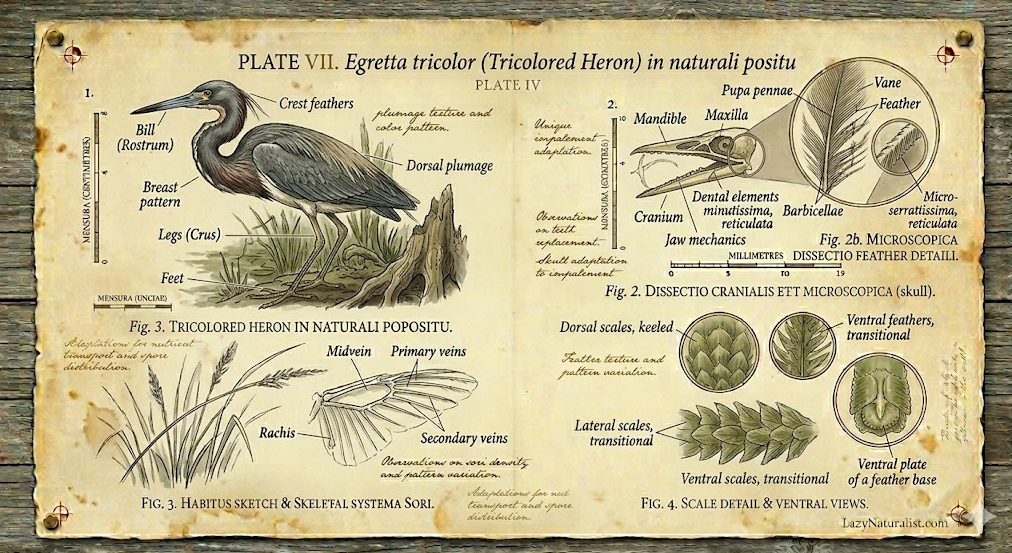
Once widely known by the evocative name “Louisiana Heron”—a moniker championed by John James Audubon himself—the Tricolored Heron is arguably the most characteristic inhabitant of Florida’s coastal and freshwater wetlands. To observe one is to witness a perfect marriage of form and function, a bird that embodies the quiet, persistent pulse of the Everglades and the Gulf Coast.
Anatomy of an Artist: Identification and Form
The Tricolored Heron is often described as “slender,” but that feels like an understatement. It is a bird of elongated lines and sharp angles. Standing roughly 26 inches tall with a wingspan of 3 feet, it occupies a middle ground in the heron hierarchy—larger than a Snowy Egret but significantly smaller and more delicate than a Great Blue.
Its namesake “tricolor” refers to a sophisticated palette that shifts depending on the light:
Blue-Gray: The head, neck, and back are draped in a deep, slatey blue.
White: A brilliant white stripe runs down the foreneck, leading to a starkly white belly. This white underbelly is the most reliable field mark for distinguishing it from the Little Blue Heron.
Lavender/Rufous: During the breeding season, the bird undergoes a transformation. The plumage develops delicate chestnut or maroon highlights, and the skin around the bill—normally a dull yellow—flushes a vivid, electric blue.
In flight, the Tricolored Heron is a study in effortless buoyancy. Its neck is tucked into a tight ‘S’ curve, and its long, dark legs trail behind like the ribbons of a kite. Unlike the steady, rhythmic flapping of larger herons, the Tricolored’s flight often feels more erratic and agile, a necessity for a bird that navigates the tangled labyrinth of mangrove roots and sawgrass.
The Florida Stronghold: Habitat and Ecology
Florida serves as one of the most critical bastions for the Tricolored Heron in North America. While their range extends along the Gulf Coast and up the Atlantic seaboard, the sheer density of suitable habitat in the Sunshine State makes it their premier stage.
The Coastal Connection
Tricolored Herons are predominantly coastal creatures. They are remarkably salt-tolerant, favoring mangrove swamps, tidal flats, and salt marshes. In places like the Ding Darling National Wildlife Refuge or the mangroves of Sarasota Bay, they are the quintessential “edge” hunters. They patrol the shallow margins where the tide meets the mud, utilizing the cover of overhanging branches to ambush prey.
Interior Adaptation
However, they are not strictly bound to the sea. Throughout the Everglades and into the chain of lakes in Central Florida, Tricolored Herons are frequent residents of freshwater marshes and cypress strands. They are often seen in the company of Wood Storks and Roseate Spoonbills, though they tend to be less social, preferring to hunt solo to avoid the “splash and dash” chaos of larger waders.
The “Drunken” Dancer: Foraging Behavior
If the Great Blue Heron is a stoic statue, the Tricolored Heron is a frantic dancer. Its hunting style is among the most animated and entertaining in the avian world. While it is capable of the standard “stand and wait” technique, it is famous for its active pursuit.
A Tricolored Heron will often sprint through shallow water, wings partially spread to create shade (which reduces glare and lures fish seeking cover), in a behavior known as “canopy feeding.” It may suddenly stop, pivot on one leg, and dart its bill into the water with lightning speed. This high-energy approach allows it to target small, fast-moving prey that more sedentary herons might miss, such as killifish, sailfin mollies, and small crustaceans.
This kinetic energy is a hallmark of the species. Watching a Tricolored Heron chase a school of minnows across a tidal flat is a lesson in fluid dynamics; they move with a frantic, seemingly disorganized elegance that almost always ends with a successful strike.
The Cycle of Life: Nesting in the Mangroves
In Florida, the breeding season for the Tricolored Heron typically begins in late winter or early spring. They are colonial nesters, often joining “heronries” or “rookeries” alongside Snowy Egrets, Cattle Egrets, and Little Blue Herons. This “strength in numbers” strategy helps protect individual nests from predators like crows, raccoons, and vultures.
Courtship and Construction
The courtship display is a theatrical affair. Males will stretch their necks skyward (the “sky-pointing” display), fluff their delicate white head plumes, and snap their bills. Once a pair bond is formed, the male gathers sticks while the female constructs a platform nest, usually nestled deep within the protective spikes of a black mangrove or a buttonwood tree.
Survival in the Rookery
The female lays 3 to 4 pale blue-green eggs. Both parents share the duty of incubation and feeding. The chicks are covered in a fuzzy, punk-rock down and are notoriously vocal, creating a cacophony of “kek-kek-kek” sounds that define a Florida rookery in May. For the Tricolored Heron, the biggest threat during this period is often the rise of sea levels and habitat loss, which can drown out coastal nesting sites or leave them vulnerable to land-based predators.
Symbology and Meaning: The Lady of the Waters
Beyond its biological statistics, the Tricolored Heron carries a weight of symbolism that has resonated with naturalists, artists, and indigenous cultures for centuries.
The Archetype of Fluidity
In many spiritual traditions, the heron is a symbol of stillness and patience. However, the Tricolored Heron, with its active hunting style, adds a layer of versatility and fluidity. It represents the ability to change tactics—to be still when necessary, but to move with decisive, explosive energy when the opportunity arises. It is a symbol of the “Middle Way,” navigating between the deep water and the dry land.
Independence and Self-Reliance
Unlike the highly social White Ibis or the colonial-feeding Wood Stork, the Tricolored Heron is often seen as a solitary figure. In bird symbolism, it represents self-reliance and the solitary path. It teaches the observer that one does not need a flock to thrive; there is power in one’s own unique rhythm and perspective.
The Mirror of the Marsh
In Florida, the Tricolored Heron is often viewed as the “Canary in the Coal Mine” for the health of the estuary. Because they rely so heavily on the specific interface between water and land, their presence is a symbol of ecological balance. To see a thriving population of Tricolored Herons is to know that the mangroves are healthy, the water is clean, and the “Lady of the Waters” still has a home.
For the artist and the writer, the bird is a symbol of understated beauty. It does not demand attention with loud colors or massive size. Instead, it invites the viewer to look closer—to see the lavender in the gray, the blue in the beak, and the incredible complexity within a seemingly simple form.
Conservation: A Fragile Future
While the Tricolored Heron is currently listed as a species of “Least Concern” globally, its status in Florida is more nuanced. It is considered a State-Designated Threatened Species. The primary threats are two-fold: habitat loss and climate change.
As Florida’s coastlines are developed for real estate and tourism, the vital mangrove fringes and salt marshes that the Tricolored Heron calls home are being fragmented. Furthermore, rising sea levels threaten to “squeeze” these habitats against seawalls and roads, leaving the birds with nowhere to hunt or nest.
Conservation efforts, such as those led by the Florida Fish and Wildlife Conservation Commission (FWC) and local Audubon chapters, focus on protecting nesting islands from human disturbance and restoring native hydrology to the Everglades. Protecting the Tricolored Heron is, in essence, protecting the very identity of the Florida coastline.
Conclusion: A Legacy in Blue and White
The Tricolored Heron is more than just a bird; it is a vital thread in the intricate tapestry of the Florida wilderness. It is the silent sentinel of the salt marsh, the energetic dancer of the tidal flat, and a symbol of the enduring beauty of the natural world.
For those who take the time to wander the boardwalks of Corkscrew Swamp or paddle the quiet creeks of the Indian River Lagoon, the reward is often a glimpse of this elegant wader. In that moment, as the sun catches the electric blue of its bill and the bird stands poised on a spindly leg, one realizes that the Tricolored Heron is not just living in the Florida landscape—it is the Florida landscape.
By preserving the “Lady of the Waters,” we ensure that future generations can witness the frantic, beautiful dance of a bird that perfectly captures the wild, wet, and wondrous spirit of the Sunshine State.
| Tricolored heron | |
|---|---|
_(cropped).jpg) | |
| A tricolored heron in full breeding plumage. | |
Scientific classification  | |
| Kingdom: | Animalia |
| Phylum: | Chordata |
| Class: | Aves |
| Order: | Pelecaniformes |
| Family: | Ardeidae |
| Genus: | Egretta |
| Species: | E. tricolor |
| Binomial name | |
| Egretta tricolor (Müller, 1776) | |
 | |
| Range of E. tricolor Breeding range Year-round range Wintering range | |
| Synonyms[2] | |
| |

The tricolored heron (Egretta tricolor), formerly known as the Louisiana heron,[3] is a small species of heron native to coastal parts of the Americas. The species is more solitary than other species of heron in the Americas and eats a diet consisting mostly of small fish.
Habitat, breeding, and distribution
Tricolored herons breed in swamps and other coastal habitats and nests in colonies, often with other herons, usually on platforms of sticks in trees or shrubs. In each clutch, three to seven eggs are typically laid. The tricolored heron is the second most coastal heron in the United States.[3]
The species' range follows the northeastern United States, south along the coast, through the Gulf of Mexico and the Caribbean, to northern South America as far south as Brazil. In the Pacific region, it ranges from Peru to California, but it is only a nonbreeding visitor to the far north.
It was likely the most numerous heron in North America until the cattle egret arrived to the continent in the 1950s.[3] While the species' population appears to be on the decline,[3] it remains quite common.[4] The bird is listed as "Threatened" by the Florida Fish and Wildlife Conservation Commission.[5]
Description
This species measures from 56 to 76 cm (22 to 30 in) long and has a typical wingspan of 96 cm (38 in).[6] The slightly larger male heron weighs 415 g (14.6 oz) on average, while the female averages 334 g (11.8 oz).[7] It is a medium-large, long-legged, long-necked heron with a long, pointed, yellowish or greyish bill with a black tip. In breeding plumage, some individuals will develop a stark bicolored bill which is blue and black at the tip. Its legs and feet turn from dark yellow in nonbreeding birds to pink in breeding adults. The plumage of the triclolored heron changes dramatically from its juvenile form to its adult form.[5]
Adults have a blue-grey head, neck, back, and upper wings, with a white line along the neck. The belly is white. In breeding plumage, they have long, blue, filamentous plumes on their heads and necks, and buff ones on their backs.[4]
Behavior and diet
The tricolored heron is more solitary when foraging than other North American herons. When it forages for its prey, it is typically belly-deep in water, alone or at the edge of a mixed flock.[3][4] Kent (1986) found that the diets of tricolored herons in Florida consisted of 99.7% fish and prawns.[8] While other members of Egretta may also eat crabs and opportunistically forage for terrestrial arthropods, the tricolored heron has been consistently observed to be almost exclusively piscivorous, primarily feeding on members of Cyprinodontidae, Fundulidae and Poeciliidae, as well as Centropomidae and Cichlidae.[3][9]
Gallery


 Flying
 Juvenile
 Between the crocodiles Tortuguero, Costa Rica


_RWD5.jpg)


Predation
In Florida, tricolored herons may be eaten by some growth stage of invasive snakes like Burmese pythons, reticulated pythons, Southern African rock pythons, Central African rock pythons, boa constrictors, yellow anacondas, Bolivian anacondas, dark-spotted anacondas, and green anacondas.[10]
References
- ↑ BirdLife International (2016). "Egretta tricolor". IUCN Red List of Threatened Species. 2016 e.T22696931A93594077. doi:10.2305/IUCN.UK.2016-3.RLTS.T22696931A93594077.en. Retrieved 11 November 2021.
- ↑ "Egretta tricolor (Statius Muller, 1776)". Global Biodiversity Information Facility. Retrieved 25 March 2023.
- 1 2 3 4 5 6 Frederick, Peter C. (2020). Poole, A.F. (ed.). "Tricolored Heron (Egretta tricolor), version 1.0". Birds of the World. Ithaca, New York: Cornell Lab of Ornithology. doi:10.2173/bow.triher.01.
- 1 2 3 "Tricolored Heron". Audubon. 2014-11-13. Retrieved 2022-12-31.
- 1 2 "The Tricolored Heron Has More Than Three Colors". Audubon Florida. 2019-07-15. Retrieved 2022-12-31.
- ↑ "Tricolored Heron". All About Birds. Cornell Lab of Ornithology.
- ↑ "Biological and Ecotoxicological Characteristics of Terrestrial Vertebrate Species Residing in Estuaries: Tricolored Heron". USGS.
- ↑ Kent, Donald M. (1986). "Behavior, Habitat Use, and Food of Three Egrets in a Marine Habitat". Colonial Waterbirds. 9 (1): 25–30. doi:10.2307/1521140. JSTOR 1521140.
- ↑ Miranda, Leopoldo; Collazo, Jaime A (1997). "Food Habits of 4 Species of Wading Birds (Ardeidae) in a Tropical Mangrove Swamp". Colonial Waterbirds. 20 (3): 413–418. doi:10.2307/1521591. JSTOR 1521591.
- ↑ Final Environmental Assessment For The Large Constrictor Snakes Listed As Injurious Wildlife under the Lacey Act. U.S. Fish and Wildlife Service. January 2012.
Further reading
- Hilty, Steven L. (2003). Birds of Venezuela. Princeton University Press. ISBN 0-7136-6418-5.
- Field Guide to the Birds of North America. National Geographic. 1987. ISBN 0-7922-6877-6.
- Stiles, F. Gary; Skutch, Alexander F. (1989). A Guide to the Birds of Costa Rica. Comstock Publishing Associates. ISBN 0-8014-9600-4.
External links
- Tricolored Heron - Egretta tricolor - USGS Patuxent Bird Identification InfoCenter
- Tricolored heron photos at Field Guide: Birds of the World on Flickr
- Tricolored heron Bird Sound at Florida Museum of Natural History
- "Tricolored heron media". Internet Bird Collection.
- Tricolored heron photo gallery at VIREO (Drexel University)
- Tricolored Heron species account at Neotropical Birds (Cornell Lab of Ornithology) (subscription required)