Commonly known as Sandhill St. John’s-Wort or Low St. John’s-Wort, this species is a testament to the evolutionary brilliance of Florida’s upland flora. While many members of the Hypericum genus prefer the soggy margins of cypress domes or wet prairies, H. tenuifolium has carved out a niche in the most well-drained, sun-scorched soils the Sunshine State has to offer.
1. Botanical Profile and Identification
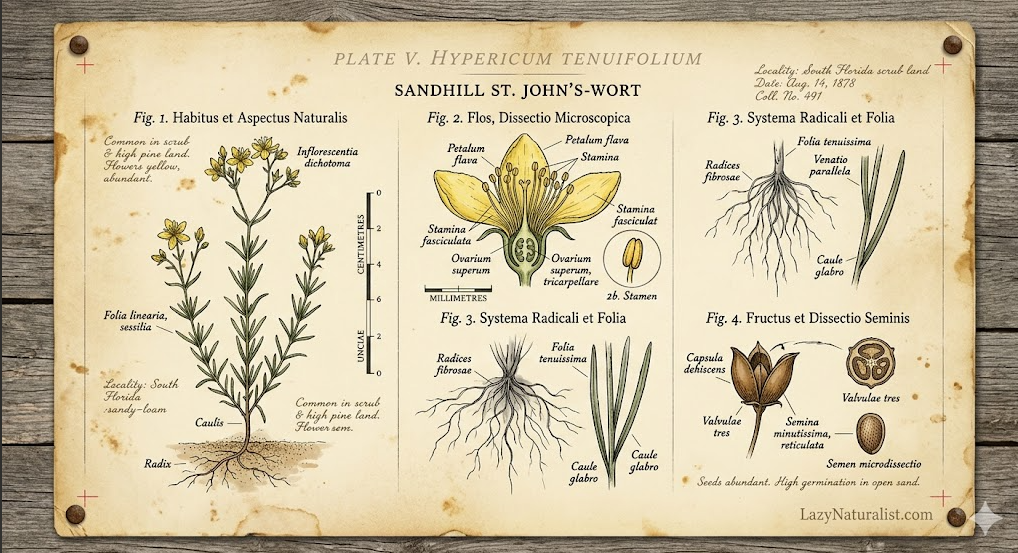
To the casual hiker, Hypericum tenuifolium might first look like a clump of oversized moss or a stray sprig of rosemary. It is a perennial subshrub, typically remaining low to the ground, rarely exceeding 12 to 18 inches in height.
Key Characteristics
Foliage: The specific epithet tenuifolium translates to “thin-leaved,” a fitting description for its needle-like, linear leaves. These leaves are sessile (attaching directly to the stem) and often appear crowded, giving the plant a soft, feathery texture.
Stems: The stems are woody at the base, providing a sturdy foundation against the shifting sands. As they age, the bark may become slightly exfoliating or thin.
Flowers: The flowers are the hallmark of the genus. They are brilliant, five-petaled, and a deep, waxy yellow. A distinctive feature of St. John’s-Wort blooms is the explosion of numerous stamens at the center, creating a “fuzzy” or “pom-pom” appearance.
Bloom Time: In Florida, you can expect to see these golden bursts primarily from late spring through the summer (May to September), though in the southern reaches of its range, it may bloom sporadically year-round.
2. Habitat and Ecology: Life in the Xeric Uplands
The Sandhill St. John’s-Wort is a specialist. You won’t find it in the shade of a dense hardwood hammock or with its “feet” in the water. Instead, it is a flagship species for xeric (dry) habitats.
The Sandhill and Scrub Ecosystems
In Florida, this species is most frequently found in:
High Pine/Sandhills: Dominated by Longleaf Pine (Pinus palustris) and Turkey Oak (Quercus laevis).
Florida Scrub: A unique, desert-like ecosystem characterized by ancient sand dunes and endemic species.
Flatwoods: Specifically the drier “scrubby flatwoods” where drainage is rapid.
The Role of Fire
Like much of Florida’s native flora, H. tenuifolium is fire-adapted. The sandhill ecosystem relies on frequent, low-intensity fires to clear out competing hardwoods and recycle nutrients. Sandhill St. John’s-Wort benefits from these burns, as the removal of leaf litter and taller competitors provides the open, sandy gaps it needs for seed germination and sunlight.
3. Distribution within Florida
While the species ranges across the southeastern United States—from North Carolina down to Florida and west to Mississippi—it finds its most diverse expressions in the Florida peninsula.
North Florida & Panhandle: It is common in the vast tracts of the Apalachicola National Forest and the sandhill regions bordering the Suwannee River.
Central Florida: It thrives along the Lake Wales Ridge, a 150-mile-long sand ridge that acts as a refugium for many rare and endangered species.
South Florida: Its presence diminishes as the landscape shifts toward the Everglades, but it can still be found in pockets of scrubby habitat in counties like Martin or Palm Beach.
4. Why It Matters: Ecological Significance
Beyond its aesthetic appeal, Sandhill St. John’s-Wort plays a vital role in the delicate web of the Florida uplands.
Pollinator Support
The flower’s dense clusters of stamens are a magnet for native bees, particularly bumblebees and leaf-cutter bees. These insects practice “buzz pollination,” where they vibrate their wing muscles at a specific frequency to dislodge pollen from the anthers. While Hypericum species generally do not produce nectar, they provide an abundance of high-protein pollen, which is essential for the survival of bee larvae.
Soil Stabilization
In the loose, nutrient-poor sands of the Florida scrub, the woody root systems of H. tenuifolium help bind the soil, preventing erosion during Florida’s intense summer afternoon thunderstorms.
5. Medicinal Context and Misconceptions
When people hear “St. John’s-Wort,” they immediately think of the herbal supplements used to treat depression. However, it is important to distinguish between species.
Note: The primary species used in herbal medicine is Hypericum perforatum (Common St. John’s-Wort), which is native to Europe and Asia.
While Florida’s native Hypericum tenuifolium contains some of the same phytochemicals (like hypericin and flavonoids), it has not been extensively studied for pharmacological use in the same way its European cousin has. Native Americans and early settlers did use various native St. John’s-Worts for topical antiseptic purposes, but one should never consume wild plants without expert guidance.
6. Cultivation in the Home Garden
For Florida gardeners looking to embrace “Florida Friendly Landscaping,” Sandhill St. John’s-Wort is an excellent candidate, provided you have the right conditions.
Growing Tips
Light
Full sun is non-negotiable. It will become leggy and fail to bloom in shade.
Soil
Extremely well-drained, sandy soil. It thrives in low-fertility areas.
Water
Once established, it is highly drought-tolerant. Over-watering is the quickest way to kill it.
Maintenance
Minimal. You can lightly prune after flowering to maintain a dense, mounded shape.
Using H. tenuifolium in a landscape design provides a beautiful contrast when paired with the silver-green of Saw Palmetto (Serenoa repens) or the purple spikes of Blazing Star (Liatris species).
7. Conservation Status
Currently, Hypericum tenuifolium is not listed as an endangered species at the federal level. However, its habitat is under constant pressure. Florida’s sandhills and scrub are prime real estate for citrus groves and residential development.
The loss of the Longleaf Pine ecosystem—which once covered 90 million acres of the Southeast and is now reduced to less than 3% of its original range—means that the “islands” of habitat where this plant thrives are becoming increasingly fragmented. Supporting land trusts and state parks that utilize prescribed fire is the best way to ensure the golden needles of the Sandhill St. John’s-Wort continue to brighten the Florida interior.
Conclusion
The Sandhill St. John’s-Wort is more than just a wildflower; it is a survivor. It represents the quiet resilience of the Florida landscape—a plant that asks for nothing more than a patch of sand and a view of the sun. Whether you are a hiker exploring the rolling hills of the Ocala National Forest or a gardener looking to bring a piece of the “real Florida” home, Hypericum tenuifolium is a species worth knowing and protecting.
| Hypericum tenuifolium | |
|---|---|
 | |
Scientific classification  | |
| Kingdom: | Plantae |
| Clade: | Tracheophytes |
| Clade: | Angiosperms |
| Clade: | Eudicots |
| Clade: | Rosids |
| Order: | Malpighiales |
| Family: | Hypericaceae |
| Genus: | Hypericum |
| Section: | H. sect. Myriandra |
| Subsection: | H. subsect. Centrosperma |
| Species: | H. tenuifolium |
| Binomial name | |
| Hypericum tenuifolium | |
| Synonyms[3] | |
| |

Hypericum tenuifolium, known as Atlantic St. John's-wort[4] and sandhill St. John's-wort,[5] is a species of flowering plant in the St. John's wort family, Hypericaceae. It is endemic[1] to the Southeastern United States.[6]
Description
Atlantic St. John's-wort is a small, spreading shrub, growing 10–50 cm (4–20 in) tall and forming mats.[6][7] The leaves are very narrow, hence its name tenuifolium (from Latin tenuis 'thin' and folium 'leaf'), and are only 0.4–0.8 mm (0.016–0.031 in) broad and 4–11 mm (1⁄8–3⁄8 in) long, with rounded tips and revolute margins. The flowerheads are narrowly cylindric, producing 1–7 flowers. Each flower is 10–14 mm (3⁄8–1⁄2 in) broad with 5 sepals, 5 bright yellow petals, and 50–90 stamens. The ovaries are three-parted, forming cylindric capsule fruits. It flowers in the summer, typically June through September, but sometimes as late as December.[5]
Distribution and habitat
Hypericum tenuifolium occurs in the Atlantic coastal plain in the southeastern United States, in Alabama, Florida, Georgia, North Carolina, and South Carolina.[6] Its habitat includes dry, open, sandy areas such as pine flatwoods, pine savannas, and sandhills.[6][5]
References
- 1 2 "Hypericum reductum". NatureServe Explorer. Retrieved 31 May 2025.
- ↑ "Hypericum tenuifolium Pursh". ipni.org. International Plant Names Index. Retrieved 2018-10-13.
- ↑ "Hypericum tenuifolium Pursh". Plants of the World Online. Royal Botanical Gardens Kew. Retrieved 2018-10-13.
- ↑ NRCS. "Hypericum tenuifolium". PLANTS Database. United States Department of Agriculture (USDA). Retrieved 2018-10-13.
- 1 2 3 Weakley, Alan S. (2018), Flora of the Southern and Mid-Atlantic States, working draft of 20 August 2018, University of North Carolina Herbarium, North Carolina Botanical Garden, University of North Carolina at Chapel Hill
- 1 2 3 4 Robson, Norman K. B. (2015). "Hypericum tenuifolium". In Flora of North America Editorial Committee (ed.). Flora of North America North of Mexico (FNA). Vol. 6. New York and Oxford: Oxford University Press. Retrieved 2018-10-13 – via eFloras.org, Missouri Botanical Garden, St. Louis, Missouri and Harvard University Herbaria, Cambridge, Massachusetts.
- ↑ "Hypericum tenuifolium". hypericum.myspecies.info. Retrieved 2018-10-13.