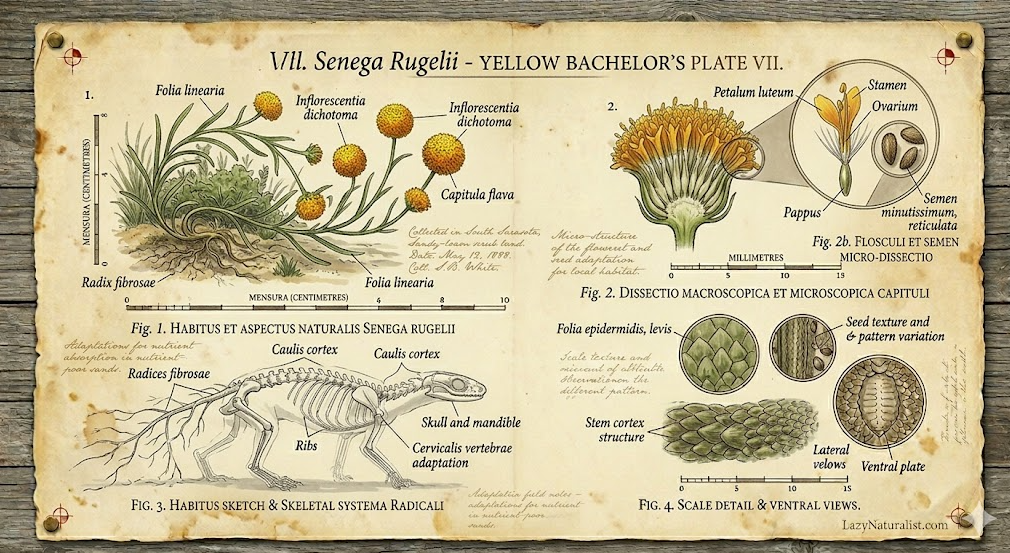
The Yellow Bachelor’s Button (Senega rugelii), also commonly known as Rugel’s Milkwort, is a quiet but radiant protagonist in the narrative of Florida’s flatwoods. Found nowhere else on Earth, this endemic species serves as a botanical signature of the peninsula’s unique hydrological and fire-driven ecosystems.
To understand Senega rugelii is to understand the delicate balance of the Florida landscape—a world where water, sand, and flame converge to support life found in no other corner of the globe.
A Botanical Profile: Anatomy of a Florida Treasure
Formerly classified under the genus Polygala, recent molecular evidence has seen the Yellow Bachelor’s Button moved to the genus Senega. This change reflects a deeper understanding of the Milkwort family (Polygalaceae), yet the plant’s physical charm remains unchanged.
The most striking feature of Senega rugelii is its inflorescence. While many members of the Milkwort family bear flowers in loose, elongated racemes, the Yellow Bachelor’s Button produces dense, cylindrical or nearly globose heads of vibrant, lemon-yellow flowers. These flower heads, typically 1 to 2 centimeters in diameter, sit atop smooth, slender stems that can reach heights of 30 to 60 centimeters.
The leaves provide a subtle contrast to the brilliant blooms. Basal leaves are often arranged in a rosette, slightly fleshy and spatulate in shape, while the cauline (stem) leaves are alternate and narrower. The entire plant possesses a specialized beauty, evolved to thrive in the nutrient-poor, acidic soils of the southeastern coastal plain.
The Geography of Endemism
Endemism is a term used to describe a species that is unique to a defined geographic location. Senega rugelii is a true Florida endemic, restricted primarily to the Florida peninsula. Its range extends from the northern reaches near the Georgia border down through the central ridge and into the southern glades, though it becomes increasingly rare as development encroaches on its native haunts.
The plant is most at home in mesic to wet pine flatwoods, a landscape characterized by:
Acidic, sandy soils: Often underlain by a “hardpan” layer that restricts drainage.
Variable Hydrology: The soil may be saturated or even shallowly inundated during the summer rainy season, only to become quite dry during the winter months.
High Light Levels: It requires an open canopy, typically provided by Longleaf Pines (Pinus palustris) or Slash Pines (Pinus elliottii).
The Fire Connection: Life in the Pyrogenic Landscape
The existence of the Yellow Bachelor’s Button is inextricably linked to fire. Florida is the lightning capital of North America, and for millennia, summer storms ignited low-intensity ground fires that swept through the flatwoods. These fires cleared out woody underbrush and leaf litter, preventing larger shrubs like Saw Palmetto or Gallberry from shading out smaller herbaceous plants.
Senega rugelii is a fire-dependent species. In the absence of regular fire (every 2 to 5 years), the “midstory” of the forest thickens, and the sunlight reaching the forest floor diminishes. Under these conditions, the Yellow Bachelor’s Button will eventually disappear from the site. When fire returns, the scorched earth provides the perfect, nutrient-rich, high-light seedbed required for this species to germinate and thrive once again.
Ecological Significance and Symbiosis
Beyond its aesthetic value, the Yellow Bachelor’s Button plays a vital role in the local food web. Its bright yellow hue is a visual beacon for a variety of pollinators, particularly bees and butterflies. While many flowers use complex scents to attract visitors, the Milkwort family often relies on specific floral structures.
The flowers of Senega have a specialized “keel” petal that often terminates in a fringed crest. This acts as a landing platform for insects. When a bee lands, its weight depresses the keel, causing the reproductive organs (the anthers and stigma) to brush against the insect’s abdomen, ensuring the transfer of pollen.
Furthermore, as a native wildflower, it contributes to the overall biodiversity that supports Florida’s unique fauna, from the Gopher Tortoise that grazes on ground-level vegetation to the myriad of insects that form the base of the avian food chain.
Conservation Challenges: The Fragile State of the Flatwoods
Despite its resilience to fire and flooding, Senega rugelii faces significant modern threats. The primary challenge is habitat fragmentation and loss. Florida’s rapid population growth has led to the conversion of vast tracts of pine flatwoods into residential developments, citrus groves, and improved pastures.
Fire Suppression: Even in protected areas, the difficulty of conducting “prescribed burns” near urban centers means that many populations are suffering from a lack of fire.
Hydrological Alteration: Ditching and draining for agriculture or development change the water table, making the soil too dry for this wetland-adjacent species.
Invasive Species: Non-native plants like Cogongrass (Imperata cylindrica) can outcompete the Yellow Bachelor’s Button, creating a dense monoculture that prevents native seed germination.
Observing the Yellow Bachelor’s Button
For those wishing to see this species in the wild, timing and location are key. While it can bloom sporadically throughout the year in the warmth of South Florida, the peak flowering period is typically late spring through early autumn.
Excellent locations for observation include:
Myakka River State Park: Its vast dry and wet prairie systems are prime habitats.
Osceola National Forest: Provides a look at the northern extent of its range.
Big Cypress National Preserve: Where the plant interacts with the unique sheet flow of the Everglades system.
When photographing or observing Senega rugelii, it is essential to stay on marked trails. The crust of the soil in flatwoods is often home to delicate mosses and lichens that are easily damaged by foot traffic, and the plants themselves are small enough to be easily overlooked and stepped upon.
Conclusion: A Symbol of the Real Florida
The Yellow Bachelor’s Button is more than just a wildflower; it is a sentinel of the pine flatwoods. It reminds us that Florida’s beauty is often found in the “knee-high” view—in the intricate patterns of a flower head and the specialized adaptations required to survive in a land of sun, water, and fire.
By protecting the habitats where Senega rugelii grows, we are not just saving a single plant. We are preserving the complex, ancient mosaic of the Florida wilderness—ensuring that the vibrant yellow “buttons” of the flatwoods continue to brighten the landscape for generations to come.
| Senega rugelii | |
|---|---|
.jpg)
| |
Scientific classification 
| |
| Kingdom: | Plantae |
| Clade: | Embryophytes |
| Clade: | Tracheophytes |
| Clade: | Spermatophytes |
| Clade: | Angiosperms |
| Clade: | Eudicots |
| Clade: | Rosids |
| Order: | Fabales |
| Family: | Polygalaceae |
| Genus: | Senega |
| Species: | S. rugelii
|
| Binomial name | |
| Senega rugelii (Shuttlew. ex Chapm.) J.F.B.Pastore & J.R.Abbott
| |
| Synonyms | |
| |


Senega rugelii, commonly known as yellow milkwort, is a species of flowering plant in the milkwort family (Polygalaceae). It grows in Florida.[2] An annual it grows up to 30 inches tall and has yellow flowers.[3]
It occurs in habitats such as cypress bays, flatwood marshes, and has been observed growing in disturbed areas.[4]
References
- ^ a b "Polygala rugelii". NatureServe Explorer. Retrieved 4 August 2025.
- ^ "Polygala rugelii - Species Details". Atlas of Florida Plants.
- ^ "Lady Bird Johnson Wildflower Center - The University of Texas at Austin". www.wildflower.org.
- ^ Florida State University Robert K. Godfrey Herbarium database. URL: http://herbarium.bio.fsu.edu. Last accessed: November 2015. Collectors: A. Gholson Jr., Robert K. Godfrey, R.A. Norris, A.G. Shuey. States and Counties: Florida: Gilchrist, Manatee, Volusia.